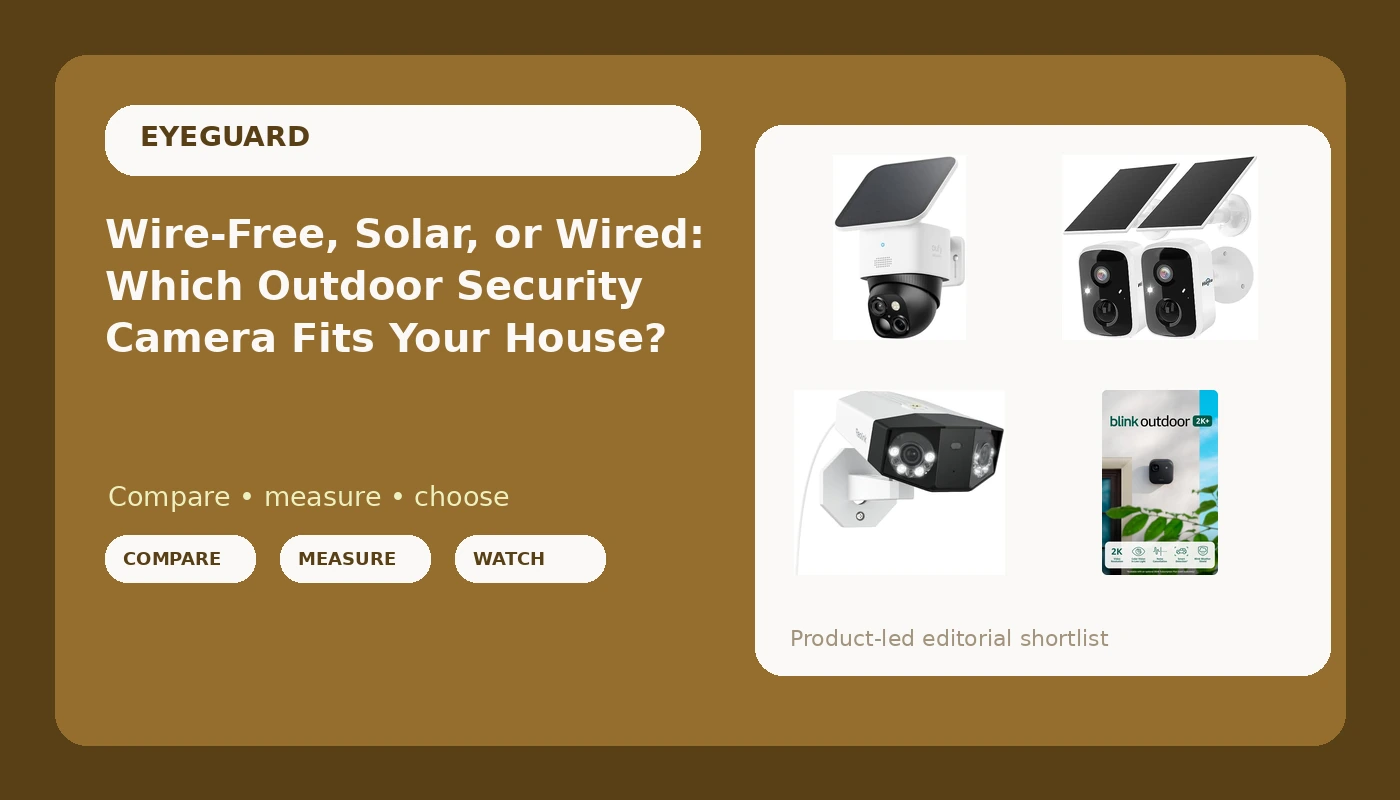
Almost nobody shops for outdoor security cameras for fun. You shop because a bike disappeared, a package walked off, or a neighbor's footage caught something yours missed. And within about ten minutes of looking, the category splits into three families that solve genuinely different problems: battery cameras you can mount anywhere, solar cameras that keep themselves topped up, and wired PoE cameras that never think about a battery again. The numbers on the box (2K, 3K, 4MP) tell you far less than you would hope about the one thing that matters, which is whether the camera can produce a face you could actually hand to a detective. This guide covers four current outdoor security cameras, what each type is genuinely good at, and how to work out which one belongs on your house.
Related: How to Stop False Alerts From Flooding Your Phone →
Quick answer
There is no single outdoor security camera that fits every house, because the deciding factors are not the camera specs. They are your power situation, your tolerance for a monthly bill, and how much of the property you need to watch. If you cannot drill, run cable, or reach an outlet, a battery kit like the Blink Outdoor 2K+ five-camera system covers several sides of a house without wiring. If you want wire-free placement but do not want to climb a ladder to swap batteries, solar models such as the eufy Security SoloCam S340 or the Hiseeu 2K solar cameras are the practical middle ground. If you can run a single Ethernet cable and want continuous power, panoramic coverage, and footage that lives on your own recorder, the REOLINK Duo 3 PoE is the wired answer. None of these four is the best camera in the abstract; each is the right answer to a different question.
Four useful options
| Model | Best fit | What stands out |
|---|---|---|
| Blink Outdoor 2K+ 5 camera system | Covering several sides of a house with zero wiring | Five wireless 2K cameras plus the Sync Module Core in one kit, two-year battery rating |
| eufy Security SoloCam S340 | Wire-free coverage you never want to recharge by hand | Dual-lens 3K design with solar charging |
| Hiseeu 2K 4MP Solar Security Cameras | A budget multi-camera WiFi setup | Solar powered, 2K 4MP, connects over 2.4G or 5G home WiFi |
| REOLINK Duo 3 PoE | Wired, always-on panoramic coverage | Dual-lens 180 degree panoramic view over a single PoE run |
The no-wiring kit: Blink Outdoor 2K+ 5 camera system
The appeal of a battery system is placement freedom. You are not choosing between the two corners of the house that happen to be near an outlet; you are choosing the corners with the best view. The trade-off is that wire-free cameras generally record events rather than running continuously, which means the clip you get depends on the camera noticing something and starting in time. Before buying any battery kit, check what the current plan terms include, because cloud clip history and some smart features are usually tied to a subscription tier rather than the hardware. Also budget for the batteries themselves. A two-year rating is a rating, not a promise, and cold weather is the enemy of every battery camera.
The solar dual-lens option: eufy Security SoloCam S340
Solar is the fix for the single biggest complaint about battery cameras, which is the maintenance. A panel that trickles charge into the battery all day means you are not scheduling a quarterly ladder climb. The catch is the sun itself. A panel mounted under a deep eave, on a north-facing wall, or in a corner shaded by a tree will not keep up, and a solar camera that quietly drains is a battery camera with extra steps. Before you commit, stand where you plan to mount it and check how many hours of direct light that spot gets in December, not in July. The dual-lens part is worth understanding too: two lenses on one body means one camera can cover an approach and a doorway instead of you buying two units, which changes the math on a multi-camera plan.
The budget solar multi-camera set: Hiseeu 2K 4MP Solar Security Cameras
The 2K and 4MP labels are worth decoding, because they are not two different quality levels. 4MP describes the sensor, and 2K describes roughly the same horizontal resolution, so a listing that says both is telling you one thing twice. What actually separates a budget camera from a premium one is rarely the resolution number. It is the sensor's low-light behaviour, the quality of the infrared illumination, and how well the person detection filters out raccoons, headlights, and moving branches. The 2.4G or 5G WiFi support matters more than it sounds, since a camera mounted at the far end of a driveway on a crowded 2.4G band is a camera that drops frames. If you go this route, treat the first week as a calibration period and watch how many alerts it sends you, because a camera everyone mutes is a camera that does not exist.
The wired panoramic option: REOLINK Duo 3 PoE
PoE is the least glamorous and most reliable way to run a camera. One cable, no outlet needed at the camera, no battery to think about, and the camera can record continuously rather than waiting for a trigger. A 180 degree panoramic view from a single mount also solves the coverage problem that makes people buy three cameras, because one unit can watch an entire side yard or the full width of a driveway. The honest cost is installation: you are drilling, you are routing cable, and you are probably buying a PoE switch or an NVR to feed it. If you rent, or if the idea of fishing cable through a soffit sounds like a weekend you will never get back, this is the wrong category for you. If you own the house and plan to stay, it is the setup you stop thinking about.
Prices and availability may change. Product images, names, and retailer links must be matched by verified ASIN. Do not state a current price, rating, stock status, or measured result without current evidence.
Resolution is not the same as night ID range
The single most useful phrase in this category is night ID range: the distance at which a camera captures a face or a plate you could actually hand to the police. Everything inside that range is evidence. Everything past it is decoration. A 2K camera with good infrared can beat a 3K camera with bad infrared at 20 feet, and no resolution number on a product page tells you which one you are buying.
The reason is infrared washout. Every camera without a spotlight lights the scene with IR, and cheap IR floods the foreground. Anything close to the lens gets blown out into a white smear while the camera struggles to reach the far end of the yard. That is how you end up with 22 minutes of a blurry raccoon and a dark shape that never becomes a face. The fix is not more megapixels, it is a camera with sensible IR balance and a mounting position that puts your target inside the range instead of at the edge of it.
Person detection is the other half of the equation. Onboard AI that filters motion down to actual humans is what keeps a camera useful, because a camera that pings you about every passing car is a camera whose notifications you turn off within a week. The catch is that person detection is much harder at night than in daylight, which is exactly when you need it. So the question to ask is not whether a camera has person detection, but whether it still works at 2 AM.
Do the three-year math, not the sticker math
The subscription is the real price. The hardware is the down payment. A camera that costs very little up front and needs a monthly plan for the clip history and features you actually want can quietly outspend a more expensive camera that stores footage locally.
Run the numbers honestly over three years, because that is roughly how long people keep a camera before replacing it. Take the hardware total, add the plan cost times 36 months, and add whatever accessories the setup requires, whether that is a memory card, a PoE switch, a recorder, or a ladder you are going to climb twice a year. Then compare the two totals side by side. The gap is often larger than the difference in the hardware prices.
Local storage changes that math, but only if you understand the limits. Footage on a card or a recorder in your house has no monthly fee and does not depend on a vendor's server staying online. It also means the card or drive is the single point of failure, and that a camera which needs a subscription to replay footage stored on your own card is not really offering local storage at all. Read the fine print before you assume a camera is subscription-free.
- Decide whether the camera can get power, and how. Battery, solar, or a cable determines everything else.
- Measure the distance from the mount to the thing you actually want to identify, not to the edge of your property.
- Count the sides of the house you need to cover. One panoramic camera sometimes beats three narrow ones.
- Decide where the footage lives, and check what you can do with it without paying a monthly fee.
- Price the whole system over three years, plan and accessories included, before you compare hardware.
Before you mount anything
- Put the camera around head height or a little above, angled slightly down, so you get faces rather than the tops of heads and ball caps.
- Aim at the approach path, not the door itself. The best identification shot is the walk up to the door, not the back of someone standing on the mat.
- Check WiFi signal strength at the exact mount point before you buy a wireless model, not from inside the house.
- Give any new camera a full week of real alerts before you trust the detection settings, then tighten the zones and sensitivity until the noise drops.
- Save one clip you would genuinely hand to a detective and look at it on a full-size screen, not a phone. If you cannot describe the person, the camera is pointed wrong or too far away.
Which option should you choose?
Choose the Blink Outdoor 2K+ 5 camera system when you need several cameras covering several sides of the house and you cannot or will not run cable. Choose the eufy Security SoloCam S340 when you want wire-free placement with two views from one mount and enough sun at the mounting spot to keep it charged. Choose the Hiseeu 2K 4MP Solar Security Cameras when the total cost of a multi-camera solar setup is the deciding factor and you are willing to spend the first week tuning alerts. Choose the REOLINK Duo 3 PoE when you own the property, can run one Ethernet cable, and want panoramic coverage with continuous power and no battery to think about.
The honest caveat is that no listing can tell you whether a specific camera will identify a face at your specific distance on your specific property. Lighting, mounting height, the angle of your driveway, and the amount of ambient light at 2 AM all change the answer. Treat every spec sheet, this one included, as a starting point, then run your own test with a person standing at the distance that matters to you, at the hour that matters to you, and judge the clip on a real screen.
The bottom line
The right outdoor security camera is the one that gets installed and stays useful. A wired PoE camera with a panoramic view is the most dependable option if you can run the cable, solar is the best compromise when you cannot, and a battery kit is what actually gets mounted when neither of those is realistic. The mistake to avoid is buying on resolution alone and assuming the rest will sort itself out. Pick the power source first, count the sides of the house, work out where the footage will live, and price the whole thing over three years. Then mount it where it can see a face, and test it at night before you need it.