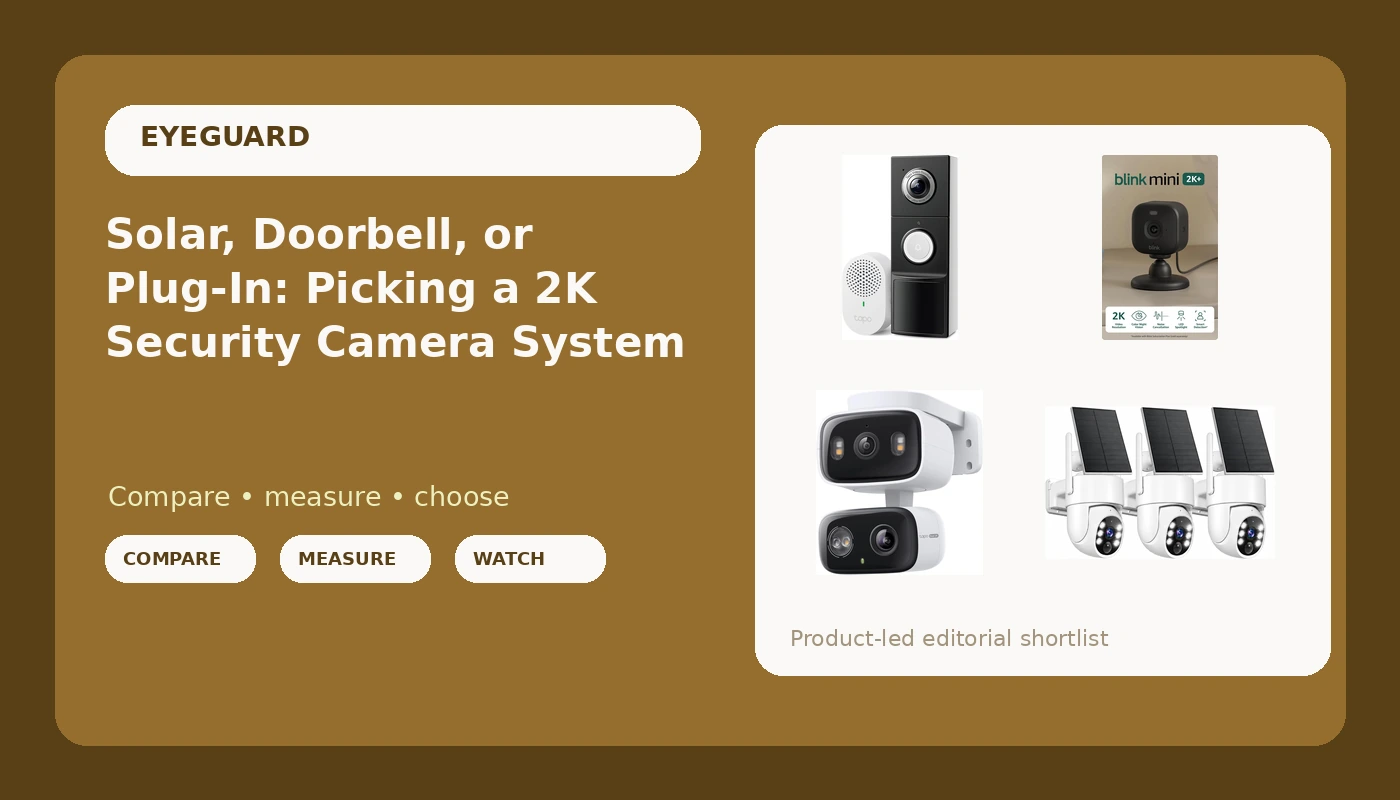
The garage door opened at 3:07 in the morning, and the camera bought a week earlier delivered 22 minutes of a raccoon and a dark shape that never became a face. No face, no case. That is the gap between a camera that records and a camera that identifies, and it is the gap most 2K security camera system listings never mention. Resolution is the easy thing to sell and the easiest thing to over-read. What actually decides whether footage is worth anything is where the camera is mounted, how it gets power, where the recording lives, and whether the alerts it sends are worth reading at 2 AM. The four options below are not ranked against each other, because they are not competing for the same job. One answers the front door, one watches the inside of the house, one sweeps a wide open area, and one builds a perimeter with no cable run at all.
Related: Night Face-ID Range: What 10, 20, and 30 Feet Actually Look Like →
Quick answer
Match the camera to the job before you compare specs. A doorbell covers the front door and porch. A plug-in indoor camera covers pets, hallways, and the room you actually worry about. A pan and tilt outdoor camera covers a wide open area from one mount. A solar multi-camera kit covers a perimeter when running cable is not realistic. Resolution alone solves none of those jobs, and neither does a camera that is still in the box.
Four useful options
| Model | Best fit | What stands out |
|---|---|---|
| Tapo 2K+ Wired or Battery Powered Smart Video Doorbell with Chime, D225 | Front door and porch | 2K+ doorbell that installs wired or on battery, with a chime included |
| Blink Mini 2K+ (newest model), Plug-in Home & Pet Indoor Security Camera with 2K video resolution, night vision, enhanced audio, motion detection, 2 cameras (Black) | Inside the house, pets, hallways | Two plug-in cameras in one purchase, 2K video with night vision and motion detection |
| Tapo 2K Indoor/Outdoor Dual Lens Pan/Tilt Wired Security Camera, C246D | Wide yard, driveway, side gate | Dual lens design with pan and tilt, rated for indoor and outdoor use, wired power |
| 2K Security Camera System, Solar Cameras for Home Security, 3 Packs | Perimeter coverage where there is no outlet | Three solar-powered 2K cameras in a single kit |
The front door: Tapo 2K+ Wired or Battery Powered Smart Video Doorbell with Chime, D225
The trade-off here is power. Battery mode is the flexible choice, but batteries need charging, and the colder the month, the more often. Wired mode means no recharging, but it depends on whether the wiring at your door supplies what the doorbell expects, and that is a question for the listing and the manual, not for a guess. Placement is the other half of it. A doorbell mounted too high gives you the top of a head and a hat. Mounted at chest height and angled slightly down, it gives you a face at the distance where faces are still faces.
The inside of the house: Blink Mini 2K+ (newest model), Plug-in Home & Pet Indoor Security Camera with 2K video resolution, night vision, enhanced audio, motion detection, 2 cameras (Black)
Indoor cameras live and die on false alerts. Point one at a window and every passing car at night becomes a motion event, and every motion event trains you to stop reading notifications. Point one at a hallway with a tight detection zone and the alerts stay meaningful. Plug-in power means no battery to think about, but it also means the camera goes where the outlet is, so plan the mount around the cord rather than the other way around. If pets are the reason you are buying, put the camera high enough that a cat walking through the frame is a detail and not the entire picture.
The wide outdoor view: Tapo 2K Indoor/Outdoor Dual Lens Pan/Tilt Wired Security Camera, C246D
Wired outdoor cameras have one hard requirement: an outlet or a power run within reach of the mount. That single constraint eliminates more camera ideas than any spec ever will, so check it before you fall in love with a model. The second thing to know about pan and tilt cameras is that a moving camera has to be aimed, either by you or by a patrol pattern, and a camera pointed at a wall for six hours is not covering anything. Mount it where the near wall is not in frame, because infrared light bouncing off a close surface is what turns a face into a white blur at ten feet.
The perimeter: 2K Security Camera System, Solar Cameras for Home Security, 3 Packs
Solar is a real solution and it is also a weather-dependent one. A panel that faces the wrong way, or a Seattle winter with three weeks of grey, changes what the camera can do, so the honest expectation is that solar reduces charging rather than eliminating it. Before buying a kit like this, confirm two things in the listing: what the cameras record to when there is no subscription, and whether you can export a clip you might need later. Those two answers decide whether the system is security or decoration.
Prices and availability may change. Product images, names, and retailer links are matched to verified listings. No current price, rating, stock status, or measured result is stated here without current evidence.
What 2K actually gets you, day and night
In this category, 2K generally means a sensor in the neighborhood of 4 megapixels producing roughly 2560 by 1440 pixels. That is a genuine step up from 1080p, and it is still not the same thing as being able to identify a person at distance. Identification depends on pixels per foot of the subject, which means a 2K camera watching a 60-foot-wide driveway spread across its frame gives you fewer useful pixels on a face than the same 2K camera watching a 15-foot walkway. Narrow the field of view, or move the camera closer, and identification improves without buying anything.
Night is where the marketing and the reality separate. Cameras see in the dark with infrared light, and infrared behaves like a flashlight pressed against a wall: anything close gets blown out while anything far stays dim. That is the blurry raccoon effect, and it is why a camera can look impressive in daylight and useless in the exact clip you needed. Person detection is the other half of the equation. Onboard AI that filters motion down to humans is only useful if it still works in the dark, and that is a claim worth testing yourself rather than trusting.
Power, storage, and the real three-year cost
Every camera here is either plugged in, wired, on battery, or on solar, and that choice decides where it can physically go. Wired and plug-in models never need charging and never miss a clip because a battery died. Battery and solar models go where no cable reaches and ask you to accept maintenance in exchange. Neither is wrong. Choosing the wrong one for a spot is.
Storage is the part that gets buried. Some cameras record to a local card or a recorder in your house, some lean on an optional cloud plan, and some do both. The question to ask before buying is not what the plan costs today, because that number moves. The question is what still works if you stop paying: does it record, does it notify, can you review and download a clip? If the answer is that live view only works while the plan is active, that is a subscription with a camera attached, and it should be priced that way in your head. Local storage keeps footage in your house, which is worth something no plan can match, and it also means the card or recorder is now your responsibility to maintain.
- Walk the property after dark and list every spot you want covered: front door, driveway, side gate, back fence, and the interior room that worries you most.
- For each spot, note whether an outlet or existing wiring is within reach. That single answer decides wired, plug-in, battery, or solar.
- Decide where footage lives before you buy: local card, local recorder, cloud plan, or both, and confirm what still works if you cancel.
- Check the field of view and the mounting height against the distance where you need a face, not just a moving shape.
- Buy for one spot first, confirm the app, the alerts, and the night picture work for your household, then expand.
Practical guidance for mounting and setup
- Mount cameras around seven to eight feet up and angle them down slightly, which puts faces in frame instead of the tops of heads.
- Keep infrared cameras away from windows and nearby reflective walls to cut the washout that turns close subjects into white blurs.
- Set tight detection zones around the walkway and door rather than the whole street, and false alerts will drop immediately.
- Test at night with a person standing at 10, 20, and 30 feet from the lens, then decide whether that clip is something you would hand to a detective.
- Download and save any clip that matters the same day, because retention windows are short and most systems overwrite without asking.
Which option should you choose?
Choose the Tapo 2K+ Wired or Battery Powered Smart Video Doorbell with Chime, D225 when the front door is the priority and you want the alert to reach the house through an included chime. Choose the Blink Mini 2K+ (newest model), Plug-in Home & Pet Indoor Security Camera with 2K video resolution, night vision, enhanced audio, motion detection, 2 cameras (Black) when you want two indoor cameras for hallways, pets, or a back room and you have outlets where you need them. Choose the Tapo 2K Indoor/Outdoor Dual Lens Pan/Tilt Wired Security Camera, C246D when one mount needs to cover a wide outdoor area and power is available at that spot. Choose the 2K Security Camera System, Solar Cameras for Home Security, 3 Packs when the fence and the far corners are the problem and running cable is not realistic.
One caveat applies to all four: none of these listings includes an independent night face-ID measurement, so treat the resolution figure as a starting point rather than a promise. Field of view, mounting height, distance, and infrared behavior decide what you can actually identify, and those are things you verify at your own address after installation.
The bottom line
Buy the camera for the spot, not the spec sheet. A doorbell covers the door, an indoor pair covers the rooms, a pan and tilt camera covers open ground from one mount, and a solar three-pack covers the perimeter where no cable reaches. Then do the unglamorous work: mount at the right height, set detection zones tight enough that you keep reading alerts, confirm where the footage lives and what happens if you cancel a plan, and run your own night test with a person at 10, 20, and 30 feet. The camera that gets mounted and aimed correctly is the one that helps. The one still in the box, at any resolution, is not security.