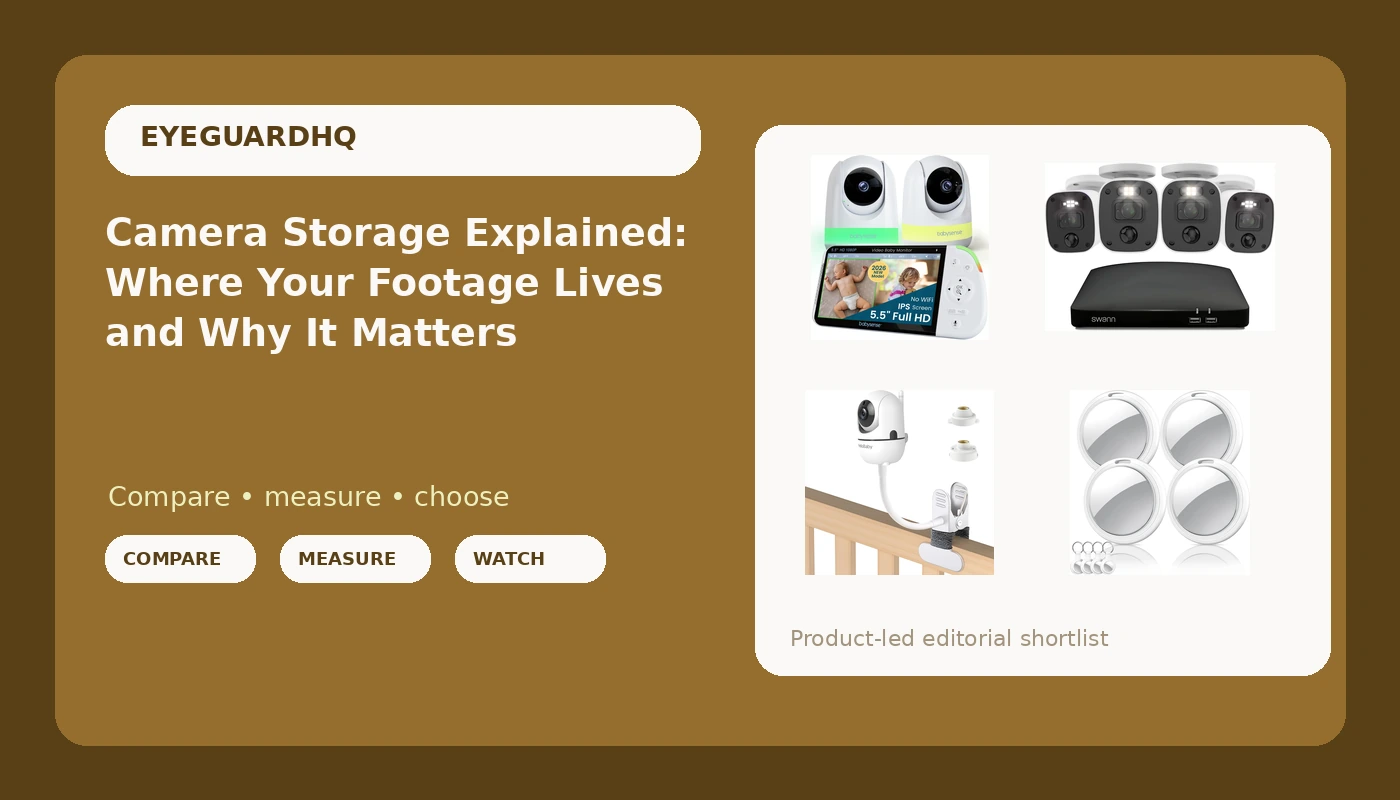
Most people buy a camera and only afterward discover that the real question was never the camera. It was home security camera storage: where the clips go, who can watch them, and how long they survive. The same 4K lens becomes a different product depending on whether it streams to someone else's server or records to a drive in your closet, and the difference shows up on the night you actually need the footage. This guide covers the four layers that make a home setup work: the recording backbone that keeps footage inside your house, a closed-loop indoor monitor for rooms you would rather keep off the network, the mount that decides whether a camera sees anything useful, and the trackers that cover what a fixed camera cannot follow.
Related: Night Vision Face ID: What 20 Feet Really Looks Like →
Quick answer
Start with storage, not resolution. A wired DVR kit records to a hard drive in your home, so replay does not depend on a subscription and no vendor holds the only copy. A closed-loop baby monitor keeps its video on a dedicated screen and off your network entirely. A clamp mount is what makes an indoor camera point at something worth recording. Tracker tags cover the objects a fixed camera cannot follow out the door. Which of those you need depends on whether your problem is a place, a room, or a thing that moves.
Four useful options
| Model | Best fit | What stands out |
|---|---|---|
| Swann Home Wired DVR 4K Security Camera System | Whole-property coverage with recording you own | 8-channel DVR, 4 outdoor bullet cameras, 1TB HDD, 24/7 recording |
| Babysense PRO Full HD 5.5" Split Screen Baby Monitor | A room you want off the internet | Non-WiFi connection, 2 cameras, split screen, 20-hour battery |
| Baby Monitor Mount Compatible with HelloBaby and ANMEATE | Fixing an indoor camera's placement | Adjustable flexible clamp, no drilling |
| Air Tracker Tags 4 Pack | The gear that leaves the property | 4 tags with cases, works with Apple Find My (iOS only) |
The recording backbone: Swann Home Wired DVR 4K Security Camera System
Wired means cable runs and holes in the exterior wall, and that is the trade you accept for a link that does not drop when the Wi-Fi gets busy or the power flickers. It also means the retention window is a physical fact rather than a plan tier: a 1TB drive fills up, and how far back it reaches depends on resolution, frame rate, and how many cameras record at once. Before buying, decide whether you want continuous recording or motion-only clips, and confirm that the app lets you export a file in a format you could hand to someone else. The recorder is the single point of failure in this setup, so where it lives matters as much as what it costs.
The closed-loop indoor camera: Babysense PRO Full HD 5.5" Split Screen Baby Monitor
A closed-loop monitor solves a different problem than a security camera: it is deliberately not reachable from the internet, which also means you cannot check it from a hotel room. That is the point, not a limitation to work around. It suits a nursery, a guest room, or any space where you would rather not add another device to the network and another account to manage. Two things are worth verifying before you buy. First, the manufacturer's stated range and how your walls will treat it. Second, whether the two cameras can actually be positioned where they see the crib rather than the ceiling, because a monitor with excellent specs aimed at the wrong wall is still aimed at the wrong wall.
The placement fix: Baby Monitor Mount Compatible with HelloBaby and ANMEATE
Placement is the cheapest upgrade in home monitoring. A modest camera mounted six feet up and aimed at a doorway beats an expensive camera sitting on a dresser aimed at a blank wall, and no sensor specification compensates for a bad angle. The catch here is compatibility: this mount is built for named monitor models, so match it against the camera you already own before ordering. If your monitor is not on that list, look for a mount made for your model rather than forcing this one into place. Also think about what the clamp is clamping to, since furniture that moves or a rail that flexes will undo a careful aim within a week.
The layer cameras miss: Air Tracker Tags 4 Pack
Cameras watch places. Tags watch things. A camera can show you that a bike left the yard at 2 AM and still tell you nothing about where it went, which is exactly the gap a tracker fills. Understand what you are buying before you rely on it: these are network-based finders that report through nearby Apple devices, not a continuous live GPS feed. That makes them genuinely useful for locating a bag, a set of keys, or a piece of luggage, and less useful for watching a route in real time. Setup and use require an iPhone or iPad, so this layer only works if your household is already in that ecosystem.
Prices and availability may change. Product images, names, and retailer links must be matched by verified ASIN. Do not state a current price, rating, stock status, or measured result without current evidence.
Why the storage decision outlasts the hardware
Cameras get replaced every few years. A recording habit does not. The question of where footage lives determines what you can do with it in the moment that matters: replay it, export it, hand it to a police officer or an insurance adjuster, or simply keep it private.
Local recording, whether to a DVR or NVR drive or to a card inside the camera, keeps the original file in your possession. There is no monthly fee to watch your own footage, and no third party who can lose it, restrict it, or hand it over on request. The cost is maintenance that you own: drives fail, cards wear out, and a recorder tucked behind a couch is a recorder nobody notices has stopped working.
Cloud recording is convenient and usually tied to a subscription, which makes the plan the real price of the system rather than the hardware. Free tiers commonly cap retention to a short window and limit whether you can download a clip at all. Before committing, price three years of the required plan next to the hardware and decide whether that number is worth the convenience. If the answer is no, buy hardware that stores locally instead of hardware that needs the plan to be useful.
What the footage has to survive: night, distance, and false alerts
A specification sheet describes ideal conditions. Your driveway at 2 AM is not ideal conditions.
Night identification is a distance problem more than a resolution problem. Infrared illumination lights the area closest to the lens far more effectively than the far edge of the frame, which is why a face ten feet away can be readable while the same face at thirty feet is a silhouette. When you plan placement, think about the distance from the lens to the spot where a person would actually stand, not the distance to the property line.
Motion detection fails in the opposite direction. A camera that alerts on every passing car, shifting shadow, and spider web trains you to ignore your phone, and a muted camera is a camera that does not exist. Person detection that filters motion down to humans is the usual fix, provided it holds up after dark, which is the only time it matters. Set detection zones over the specific approaches to doors, gates, and driveways rather than lowering global sensitivity until the alerts stop being useful.
A five-step way to choose
- Decide where footage will live before you compare cameras, because a cloud-only camera and a DVR kit are different purchases with different ongoing costs.
- Measure the distance from your intended mount point to the place a person would stand, and treat that number as the specification that matters most.
- Count how many alerts per night you are willing to receive, then pick detection features that can realistically meet that number.
- Add up three years of any required subscription and compare it with the hardware price before deciding the camera is affordable.
- Install the camera and walk the coverage area at night before you trust it, because a camera still in the box protects nothing.
Practical guidance before you buy
- Put the recorder somewhere you will notice it, with airflow and away from a closed cabinet, so a failed drive is visible rather than silent.
- Check power and cable routes before ordering a wired system; the hardware is the easy part and the cable run is the actual project.
- Use detection zones on the approaches to doors, gates, and driveways instead of lowering sensitivity across the entire frame.
- Confirm requirements before buying, including phone platform for the trackers and monitor model compatibility for the mount.
- Learn the export process the day you install the camera, not the day you need to hand footage to someone.
Which option should you choose?
Choose the Swann Home Wired DVR 4K Security Camera System when you want continuous coverage of the outside of a house and you would rather own the recording than rent it. Choose the Babysense PRO Full HD 5.5" Split Screen Baby Monitor when the room you care about is indoors and you want its video kept off the internet. Choose the Baby Monitor Mount Compatible with HelloBaby and ANMEATE when the camera you already own is fine but its placement is not, and check the compatibility list first. Choose the Air Tracker Tags 4 Pack when the things you worry about are portable, and remember that they need an iOS device.
These four items do not compete with each other. They cover a place, a room, a placement problem, and a moving object, and none substitutes for another. The specifications above come from the manufacturer rather than from a controlled side-by-side test, so verify range, compatibility, and platform requirements against your own home before ordering.
The bottom line
Storage first, camera second. A wired DVR system keeps continuous footage on a drive you own, which is the most durable answer for the outside of a house and the one with no recurring fee to replay your own clips. A closed-loop monitor does the opposite kind of work indoors, trading remote access for a video feed that never touches your network. The mount and the trackers are the small pieces that decide whether the rest of it functions: one gets a camera aimed at something worth recording, the other follows the objects a camera can only watch leave.