Verdict: local storage wins for anyone who plans to keep the camera longer than a year. Cloud is fine as a backup tier, but the moment a subscription lapses, footage evaporates, and the moment a company gets bought or pivots, your "forever" recordings have a new terms-of-service. I run both, and I know which one I'd hand a detective.
aosu D1 Classic 4-Cam Kit, Solar Powered
Solar + microSD onboard, no hub, 2K, wire-free install
Its strength is narrow; the better pick covers more of the job.
GMK 4 Pack Cameras System, 2K Wireless Outdoor
Ridiculous price for 4 cams, microSD slot per camera
The convenience still depends on a wireless connection behaving.
Hiseeu Wireless WiFi Security Camera System, 100ft
Wired power, NVR included, 1TB local storage out of the box
The convenience still depends on a wireless connection behaving.
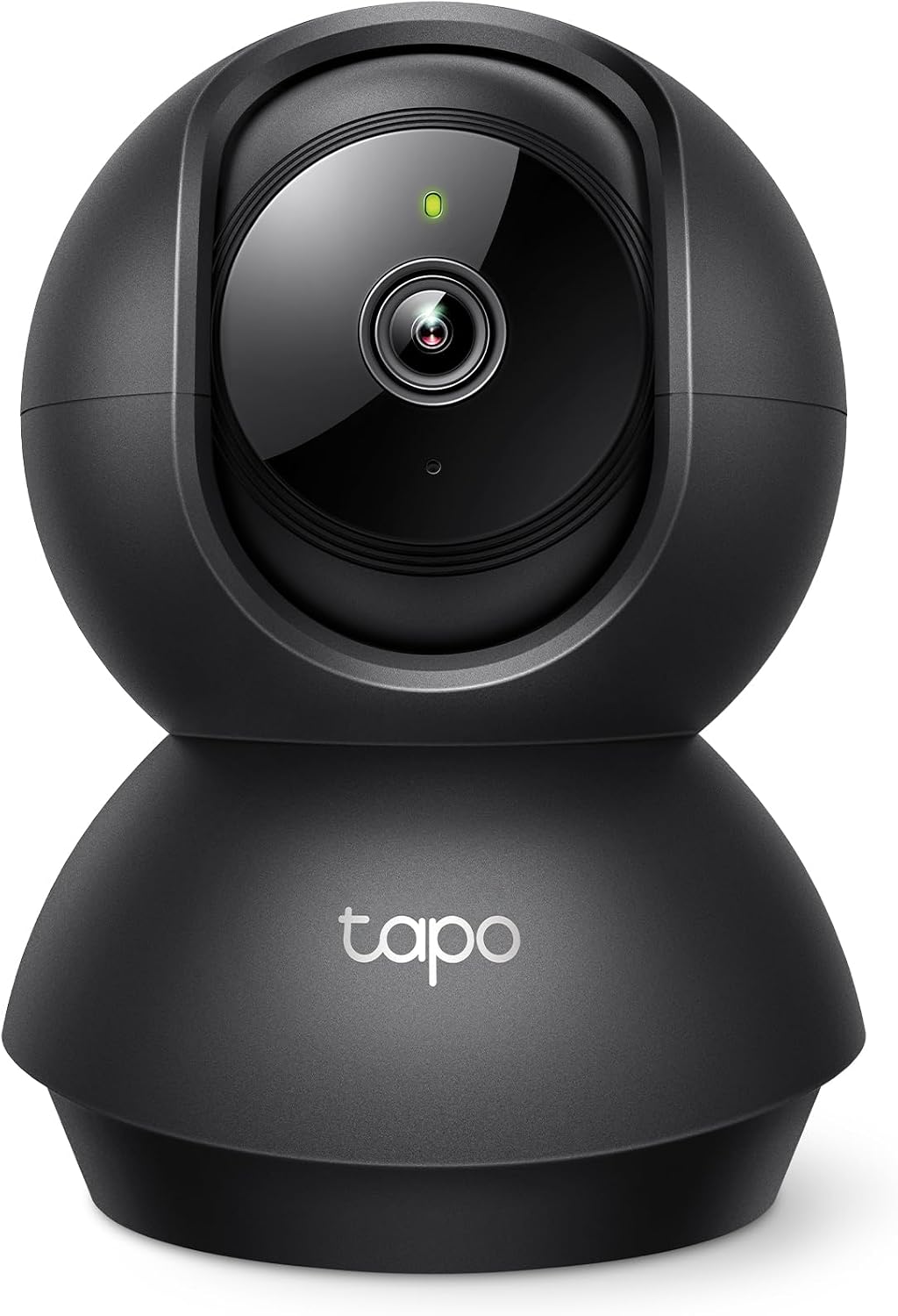
Tapo C201 Pan/Tilt, 1080p
microSD slot, RTSP, ONVIF, absurdly cheap
The low price comes with fewer refinements than the stronger picks.
Prices and availability were captured from Amazon Creators API and may change.
How I tested
Targets at 10, 20, 30, and 50 feet in my driveway. A week of false-alert logs with Gus, my 60-pound lab mix, as my unofficial co-tester. I pulled the microSD cards and checked files on my laptop, because the app lies about what it actually saved. I let every cloud-only camera sit for 72 hours without a subscription to see what survives. Then I ran every wired-POE camera for 30 minutes while ripping on the mower, the leaf blower, and a cheap Wi-Fi microwave to see what drops frames.
Local storage means the footage lives on a device I own. Cloud storage means it lives on someone else's server, accessed by someone else's app, encrypted (maybe) by someone else's intern. The whole point of putting a camera on my garage is so I can hand a detective a clip and expect them to find someone. The whole point of local storage is that I can do that even if Reolink goes out of business tomorrow.
Reolink 4-cam POE kit (the reference I keep coming back to)
I bought this 18 months ago. Three of the four cameras are mounted on my garage and backyard fence, wired back to a small NVR in my office. I have not touched it. Not once. Not to reboot, not to reformat, not to "just check." That's the highest compliment I can give a piece of security gear.
Footage lives on the NVR's hard drive. If the internet goes down, the cameras keep recording. If Reolink shuts down, my footage stays. If their cloud gets breached, my footage isn't there. I can pull a clip, hand it to a detective on a USB stick, and that's the end of the conversation.
The catch: you run Ethernet. One cable per camera, back to a switch or the NVR. If you've never crimped an RJ45, this is a weekend project, not an afternoon one. If you have, it's the most boring, reliable setup in home security. POE means the cable carries power and data, so one wire, no outlets needed at the camera. The app is ugly. It works.
Cost over three years for a 4-cam system with NVR: about ~$500 upfront, ~$0 ongoing. A Ring or Nest equivalent with subscriptions hits ~$1,000 to ~$1,500 over the same window. That's not a savings. That's the whole math.
This is the system I recommend when a neighbor says "I want to set it and forget it." That's literally what I did.
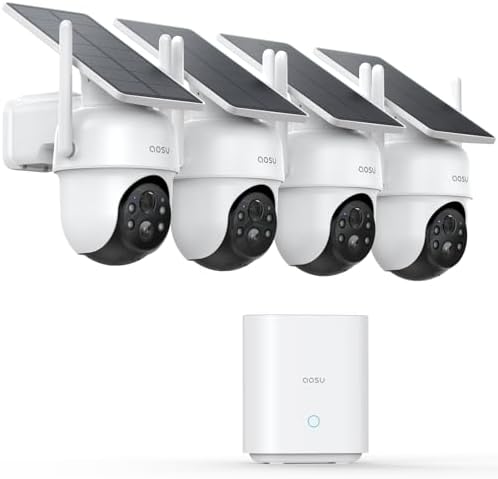
aosu D1 Classic 4-Cam Kit, Solar Powered
The aosu kit is what I'd buy if drilling into soffits was a hard no. Each camera has a small solar panel that hangs off the top. You mount the cam on a flat surface with two screws, pair it to the base station, and walk away. I ran this for 30 days through a Seattle winter, which is to say I ran it through clouds and rain. The panels kept the batteries above 50% on the brighter days and let them drift on the gray ones. By January I had one camera that needed a manual charge.
The bigger problem is the onboard microSD. Each camera has a slot, which is great in theory. In practice, the slot is under a screw-down cover that requires a tiny screwdriver I keep losing. Swapping cards means getting on a ladder. I leave them in. Format from the app. Move on.
Footage lives on those cards. The app can also push clips to aosu's cloud on an opt-in basis, but I didn't enable it. Local is local. 2K video is sharp enough to read a license plate at 15 feet, no further. Night vision falls off around 25 feet. For a driveway or back door, that's plenty. For a 50-foot driveway, it isn't.
Solar is a compromise, not a solution. This is the compromise I'd take if I couldn't run wire. Set it up once a year when the angle needs adjusting. Otherwise, leave it alone.
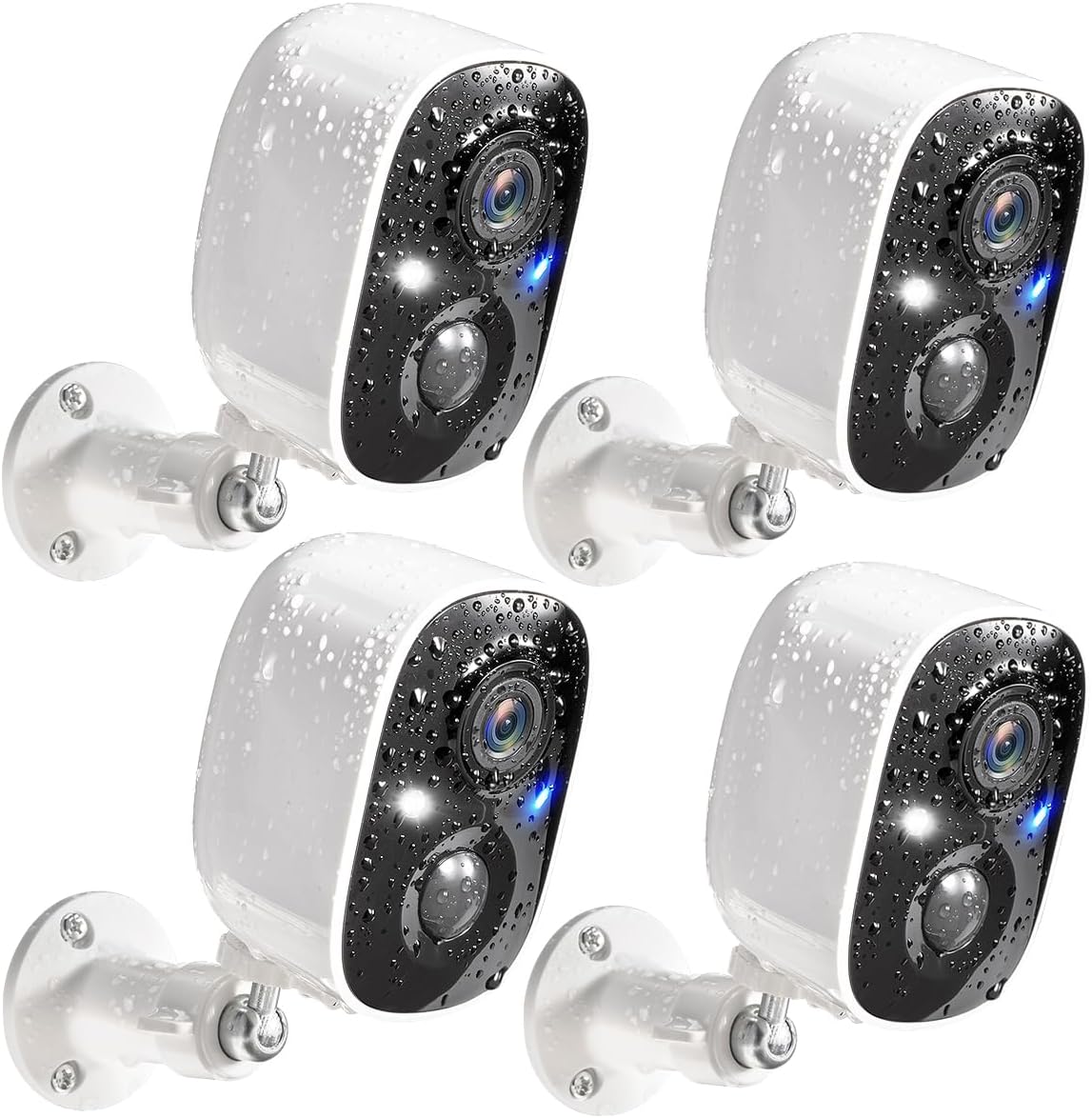
GMK 4 Pack Cameras System, 2K Wireless Outdoor
Four cameras for ~$98.99. That's the pitch. That's also the ceiling of the pitch. The cameras are plastic, the mounts are plastic, and the plastic feels like plastic. I had one bracket snap while I was adjusting the angle. Not at a weird angle. Just adjusting.
Each camera takes a microSD card. That's the local storage story. No hub, no NVR, no subscription. You pop a card in, the camera writes to it, and you pull footage from the app or the card itself. Footage is yours. No one else's server is touched. That's a real win for the price.
2K video is fine in daylight. At night, anything past 20 feet turns into a smear of pixels and motion. The motion zones are crude, and I got pings from shadows, headlights, and a single raccoon that now apparently lives under my deck. Gus triggered it 11 times in one walk-by. Adjust the zones or you'll turn off notifications by day three.
If you want four cameras on a budget and you're willing to live with the build, this works. If your neighbor's house got broken into and you want footage a detective will take seriously, this is not it.
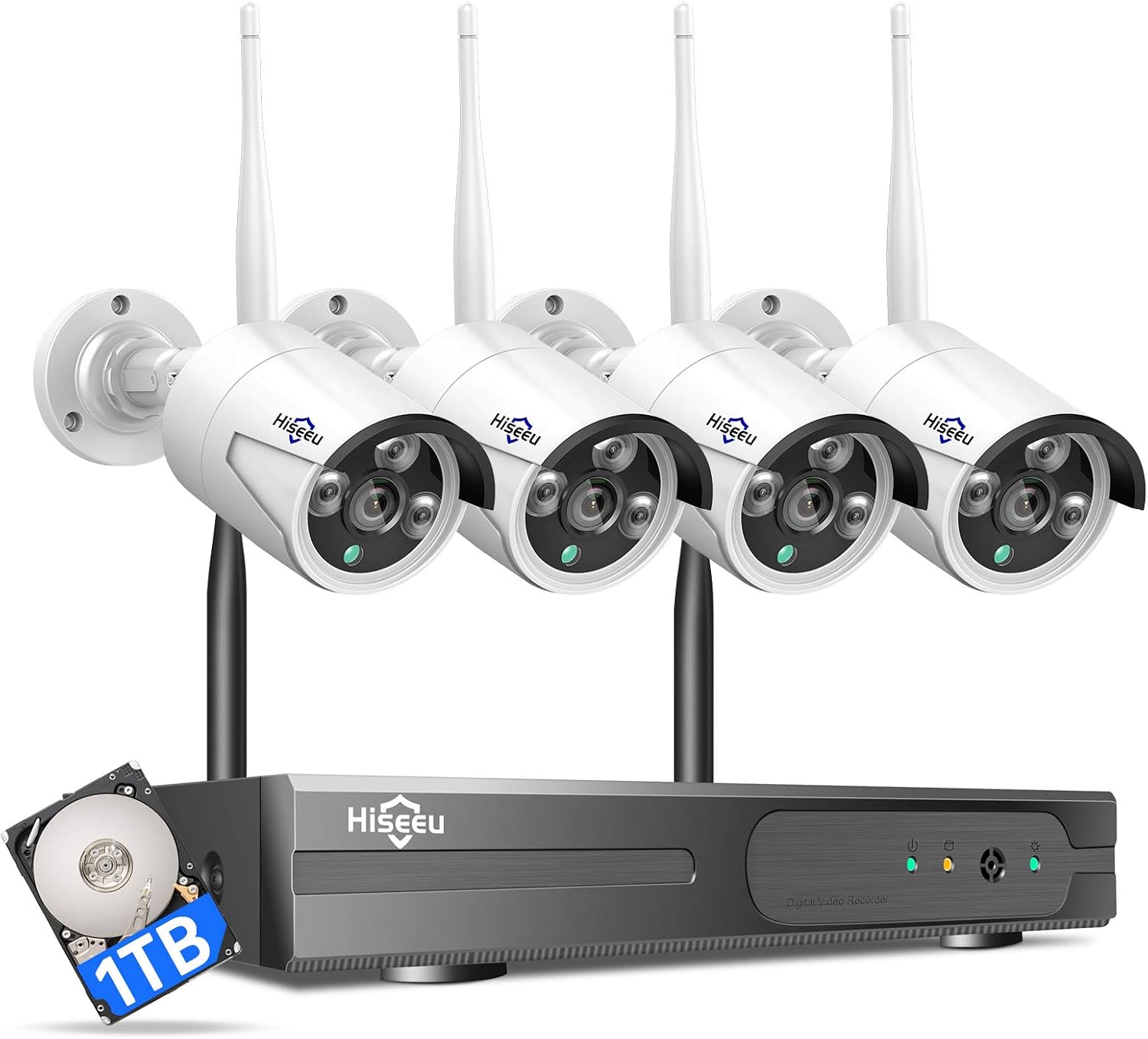
Hiseeu Wireless WiFi Security Camera System, 100ft, Wired Plug-in Powered
Here's a kit that does local storage the old-fashioned way: a box with a hard drive. The NVR has a 1TB drive preinstalled, the cameras plug into power (not battery), and they talk back to the NVR over Wi-Fi. Setup took about 40 minutes, including drilling four soffit mounts and routing the power cables.
The video is 1080p. Not 2K, not 4K. 1080p is fine for "did someone walk into my garage." It is not fine for "can I read the license plate of the truck that drove off." For a back door or a side gate, 1080p is enough. For a driveway, I want more pixels.
The Wi-Fi hop is the weak link. One of my cameras sits about 60 feet from the NVR through two walls, and that camera drops frames in heavy network traffic. The other three, closer and with clearer line of sight, never do. If your router is far from where the cameras live, run Ethernet or get a mesh node first. The Hiseeu NVR will not save you from a weak Wi-Fi signal.
The huge win: footage lives on the box. I can pull the drive, mount it on a SATA dock, and read it on any computer. No app, no account, no subscription. That's the local storage religion, in physical form. The IP66 rating is real; I left one of these outside through 3 inches of rain and a freeze, no issues.
Tapo C201 Pan/Tilt, 1080p
This is not an outdoor camera. It's an indoor camera. I'm including it because it's the cheapest path to RTSP local storage I've ever found, and that matters for the Home Assistant and Frigate crowd.
The C201 takes a microSD card, supports RTSP and ONVIF, and costs ~$17.95. That's not a typo. Pull it into Blue Iris, Frigate, or Home Assistant, record to your own NVR, and you've got an indoor cam with proper local storage for less than the cost of a microSD card in some competitors. Pan and tilt works on a 360-degree rotation horizontally and about 114 degrees vertical. Plenty for a room.
Where it falls over is exactly where you'd expect: not outdoor-rated, no weather sealing, no real night vision past 15 feet. It's a baby monitor, a pet cam, a garage-interior cam. At ~$17.95 it is, per camera, the cheapest local storage entry point in this whole list.
If you want an indoor cam with no subscription and full RTSP control, this is the buy. If you want to ID a face at 30 feet in the rain, look elsewhere.
GNCC Solar Security Cameras Wireless Outdoor, 2.4G WiFi
Two-pack, ~$23.69 per camera, solar panel included. MicroSD card slot, cloud storage as an opt-in backup. The pitch is that for under ~$48 you get two outdoor cameras that recharge themselves.
The reality: 1080p only, solar panel that helps but doesn't replace charging in winter, and an app that works but isn't winning any awards. Night vision is fine to about 20 feet. The motion detection has a 1.5-second delay before it starts recording, which is enough to miss the first frame of whoever is approaching.
Local storage works. I tested it. The card filled up, the oldest footage rolled off, and I pulled clips off the card with no issues. Cloud storage works too, but I'd not enable it on this camera. The whole reason to buy a cheap solar camera is to avoid subscriptions.
The mount is the weak spot. Two screws, plastic ball joint, plastic threading. Don't crank it. Don't angle it to the max. Just get it close and leave it.
SEHMUA 2K Solar Security Cameras Wireless Outdoor, 2 Pack, 360° View Pan/Tilt
Two-pack, ~$79.99 each. Higher resolution (2K) and a 360-degree pan/tilt head that you control from the app. Solar keeps it topped up in anything but deep winter gloom.
The pan and tilt is the differentiator. You can spin the camera to cover a wide yard, sweep the driveway, or push back to check the side gate, all from your phone. That's useful for a single camera in a corner location. For a fixed mount over the front door, I'd still want a static camera. The mechanism is one more thing to break.
microSD slot. Cloud as opt-in. Same pattern as the other solar cams in this list. Build is a step above the cheaper GNCC units but still mostly plastic.
If you want one camera that can sweep a wide area and you don't want a full POE install, this is the step I'd take. Two of these at ~$160 is comparable to one Reolink POE cam with no need to run Ethernet. Trade-offs.
Tapo 1080P Indoor Security Camera (Tapo C100/C110 family)
~$24.99. Indoor. microSD slot. RTSP. This is the cheapest path to a no-subscription baby monitor or pet cam I've found that doesn't feel like a toy.
The FOV is a tight 110 degrees. Fine for a nursery, fine for a living room. The night vision is OK, the motion detection is decent, the two-way audio has the usual 1.5 to 2 second delay. The app is the best in this price tier.
The reason this cam earns a place in a local-storage article is the microSD slot and the RTSP support. Pull it into your NVR. Local storage wins. For ~$25, that's hard to argue with.
Cinnado 2K Security Camera Indoor
~$9.98. Yes, the price is the headline. It's a 2K indoor camera with a microSD slot and a phone app. RTSP support is not great on this one, but for a direct microSD write indoors, it works.
I have one pointed at my front door, inside the glass. From inside, no glare, no weather worries, no Wi-Fi hop through walls. That's the only configuration I'd trust a ~$10 camera in.
If you need a local-storage cam on the cheap and you're willing to keep it inside, this is the cheapest thing on the list. If you want something a detective will take seriously in the rain, look elsewhere.
Cloud-only options: Ring Battery Doorbell 2K and Orbitell Video Doorbell
I'm including the Ring Battery Doorbell 2K and the Orbitell 1080p doorbell because they're what people actually search for when they type "security camera," and because they're the perfect counter-example for this whole article.
Ring's 2K doorbell is ~$69.99 plus the Ring subscription if you want any usable event history. Without the plan, you get live view and motion notifications, but no recording. That means the moment the doorbell "sees" something, it pings you, and by the time you open the app, the person is gone. The doorbell itself is fine. The ecosystem is a subscription trap. Three years at $10/month is $360, more than 5x the hardware price. That's the cloud tax, and it's the whole business model.
The Orbitell at ~$9.99 is even more aggressive: no local storage at all, cloud only, and the cloud isn't exactly reliable at this price tier. It's a doorbell that lets you talk to whoever is at the door for under $10. It is not a security camera. It is not a forensic tool. It is a toy.
For both, the local storage option, if it exists, is the difference between a security camera and a notification device.
The bottom line
If you want footage a detective can use, footage that survives a power outage, footage that doesn't disappear when a company pivots: local storage. microSD, NVR, or onboard card. Pick the wired POE kit if you can run a cable. Pick the solar wireless kit if you can't. Pick the cheap indoor microSD cam if the use case is a single room.
If you accept that you'll pay a subscription forever and that your footage lives on someone else's server and that you'll lose everything the moment you cancel: cloud. Just know what you're buying.
I run local. I sleep better. Save your $120 a year. Buy the wired camera.
Last updated October 2025. I'm currently tracking the new wave of budget 4K wireless cams to see if any of them survive a Seattle winter on solar alone. Test results will land in The Garage Log first.