At 3:07 on a February morning, someone pried open the side door of my garage and walked out with two bikes, a toolbox, and my late father's camping gear. My camera recorded 22 minutes of it. What it handed the detective was a blurry raccoon and a dark shape that never once became a face. "No face, no case," he said, politely. Shopping for indoor and outdoor security cameras is where that lesson gets tested, because the language on the box and the footage you actually get at 2 AM are two different products. This is a look at four cameras with four different jobs, and at the three questions that decide which one belongs on your house: can it identify a person after dark, where does the footage live, and what does it really cost over three years.
Related: How to Read a Security Camera's Night Vision Specs →
Quick answer
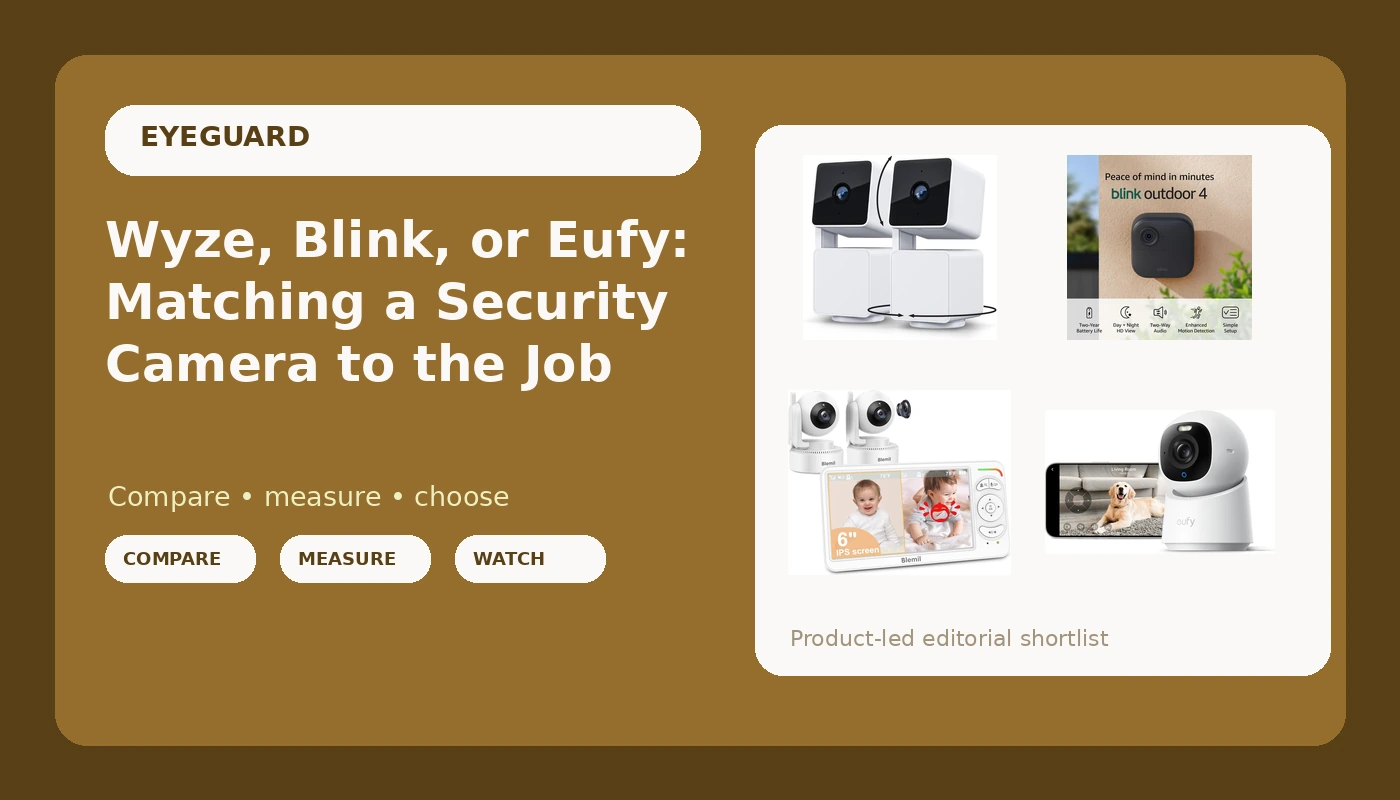
Match the camera to the job instead of ranking them against each other. The WYZE Cam Pan v3 moves its own lens, so a single mount can cover a wide area indoors or outside. The Blink Outdoor 4 system is a five-camera wireless kit with the Sync Module Core included, which suits a property where running cable is not practical. The Blemil monitor is a dedicated baby monitor with its own screen and two cameras, not a cloud camera. The eufy Security 4K Indoor Camera E30 is an indoor 4K camera sold without a subscription and positioned for pet watching as well. Each of these is a sensible choice for a specific job and a poor one outside it, so the decision is about your layout, not about a winner.
Four useful options
| Model | Best fit | What stands out |
|---|---|---|
| WYZE Cam Pan v3, Indoor/Outdoor Security Camera with 360° Pan/Tilt/Zoom | One mount that has to cover a wide area | Motorized 360° pan, tilt, and zoom, rated for indoor and outdoor use |
| Blink Outdoor 4, Wireless smart security camera, two-year battery life, 1080p HD day and infrared night live view, two-way talk. Sync Module Core included, 5 camera system | Covering several points of a property without cable runs | Five wireless cameras, Sync Module Core included, two-year battery life rating |
| Blemil 6" Split Screen Video Baby Monitor with 2 Cameras, 4000mAh Battery | Watching two rooms on a dedicated display | 6 inch split screen, two cameras included, 4000mAh battery |
| eufy Security 4K Indoor Camera E30, No Subscription, Work as Pet Camera | Indoor detail without a subscription | 4K indoor resolution, no subscription, pet camera use |
The pan-and-tilt option: WYZE Cam Pan v3, Indoor/Outdoor Security Camera with 360° Pan/Tilt/Zoom
The trade-off with any moving camera is that it sees one direction at a time. If you need to watch a single choke point, like the side door, a fixed camera aimed correctly is simpler and has fewer parts to fail. If your problem is a yard or a room where you do not know which angle matters yet, a pan-and-tilt unit lets you find that angle from your phone and then leave it there. The other thing to check is the mount: pan and tilt only help if the camera has a clear line of sight in the directions you care about, and a corner placement usually beats a central one for that.
The multi-camera kit: Blink Outdoor 4, Wireless smart security camera, two-year battery life, 1080p HD day and infrared night live view, two-way talk. Sync Module Core included, 5 camera system
Battery cameras buy their freedom with a behavior change: they do not record continuously, they wake when something moves. That is why the battery rating on the box is a best case, and why clip volume matters more than the number printed on the spec sheet. The upside is real, though. Five cameras means you can cover the front door, the driveway, the side gate, the back fence, and the garage without an electrician, and the included Sync Module Core is what ties that group together. Just be honest with yourself about resolution: 1080p is a fine working standard, and it will not resolve a face at the far end of a long driveway the way a higher-resolution sensor might.
The dedicated monitor: Blemil 6" Split Screen Video Baby Monitor with 2 Cameras, 4000mAh Battery
This is a different category of device, and it is worth saying plainly: it is not a security camera and should not be judged as one. There is no app to open from the office and no cloud account to manage. What you get instead is a closed loop between two cameras and a screen that sits on your nightstand, which sidesteps the entire subscription conversation and keeps working when your internet does not. If the thing you are actually watching is a sleeping infant in the next room, that simplicity is a feature. If you want to check the driveway from a hotel, this is the wrong tool.
The no-subscription indoor camera: eufy Security 4K Indoor Camera E30, No Subscription, Work as Pet Camera
The word "indoor" is doing a lot of work in that name. This camera is for rooms, entryways, and pet zones, not for a garage door that faces the street in February. The reason it earns a place in this list is the subscription stance: a camera you can use without a recurring plan is a camera you will still be running in year three, and 4K inside a room is a genuinely useful amount of detail for reading a face or a delivery label at close range. If your garage is the problem, pair it with an outdoor unit rather than expecting this one to handle weather.
Prices and availability may change. Product images, names, and retailer links are matched to verified listings. No current price, rating, stock status, or measured result is stated here without current evidence.
What night vision claims leave out
"Night vision" on a product page usually means the camera has infrared LEDs. It does not tell you the distance at which those LEDs produce a usable image, and it definitely does not tell you the distance at which they produce an identifiable face. The failure mode has a name in my notebook: IR washout. The camera blasts infrared at full power, overexposes anything within a few feet, and leaves the far end of the frame a gray smear. A camera can light up 50 feet and still hand you a white blob at 8.
That is why the only number worth caring about is night ID range, the distance at which you get a face or a plate you could actually hand to a detective. Resolution helps, but it is not the same thing: a high-resolution sensor pointed at a badly lit yard still gives you a high-resolution silhouette. Frame rate and shutter behavior matter too, because a person walking at a normal pace can smear across a slow exposure.
Here is the method I use, and it costs nothing to copy. Put a person at 10 feet, then 20, then 30, then 50. At each distance, have them stand still, walk toward the camera, and walk across the frame. Do it once with the porch light on and once with it off. Write down the first distance where you would not recognize your own neighbor. That number is the camera's real specification, and it is the one no listing will print for you.
The subscription is the real price
The hardware is the down payment. A cloud plan is usually billed per camera, per month, which means a five-camera kit can carry a recurring cost that dwarfs the box it came in. Do the arithmetic before you buy, not after: monthly plan multiplied by 36, multiplied by the number of cameras, plus the hardware. Then compare that to a camera whose footage lives on a card or a base station in your own house.
Free tiers deserve the same suspicion. A free plan that keeps a day of clips you cannot export is not storage, it is a preview. Ask three questions of any camera you are considering. Can I record without a plan? Can I download the clip and keep it? If I cancel, do I still have anything? If the answer to the first is no, the subscription is not optional and it belongs in the price.
My own position is not subtle: local storage beats cloud trust, because footage in your house is footage nobody else can quietly lose. I also keep a cloud backup of my garage clips, which tells you how much a break-in rewires your principles.
- Decide what the camera is for: identifying a person, watching a pet, or monitoring a room. Those are three different products.
- Measure the distances you actually need covered, from the mount to the far edge of the area, and write them down.
- Check where the footage lands by default, and whether you can export a clip without paying.
- Add up three years of hardware plus any mandatory plan before you commit to a system.
- Mount one camera first, live with its alerts for a week, then decide whether you need the other four.
Mounting decisions that beat spec sheets
- Put the camera at roughly head height or a little above. A camera looking down from the eaves sees the top of a hood, not a face.
- Aim it so a person walking toward the house is lit by your porch light, not backlit by the street.
- Set detection zones tight around the actual entry points, because a camera that pings you about every passing car is a camera you will mute.
- Check your Wi-Fi signal at the mount before you drill. A weak signal produces dropped clips, not just slow ones.
- Keep the box and the receipt until you have run the camera for a full week of nights. That is the only honest trial period.
Which option should you choose?
Choose the WYZE Cam Pan v3, Indoor/Outdoor Security Camera with 360° Pan/Tilt/Zoom when one mount has to cover a wide area and you want to aim it remotely from your phone. Choose the Blink Outdoor 4, Wireless smart security camera, two-year battery life, 1080p HD day and infrared night live view, two-way talk. Sync Module Core included, 5 camera system when you need several points covered and running cable is not realistic. Choose the Blemil 6" Split Screen Video Baby Monitor with 2 Cameras, 4000mAh Battery when the job is watching two rooms on a dedicated screen with no account and no monthly fee. Choose the eufy Security 4K Indoor Camera E30, No Subscription, Work as Pet Camera when you want indoor detail and a pet camera in one device without a subscription attached.
One caveat applies to all four. None of these listings tells you the distance at which they will identify a face at night, and I am not going to guess at that number for a camera I have not measured. Treat the specs above as what the manufacturer states, and treat the mounting and lighting advice as the part you control.
The bottom line
The camera that catches someone is the camera that was mounted correctly, aimed at head height, and pointed where a person has to walk. Everything else is marketing. Start with the job, then the distance you need to identify a face, then where the footage lives, then the three-year cost. If you do those four things in that order, the choice between these four cameras stops being a ranking and becomes obvious, and you will not be the person handing a detective 22 minutes of raccoon.