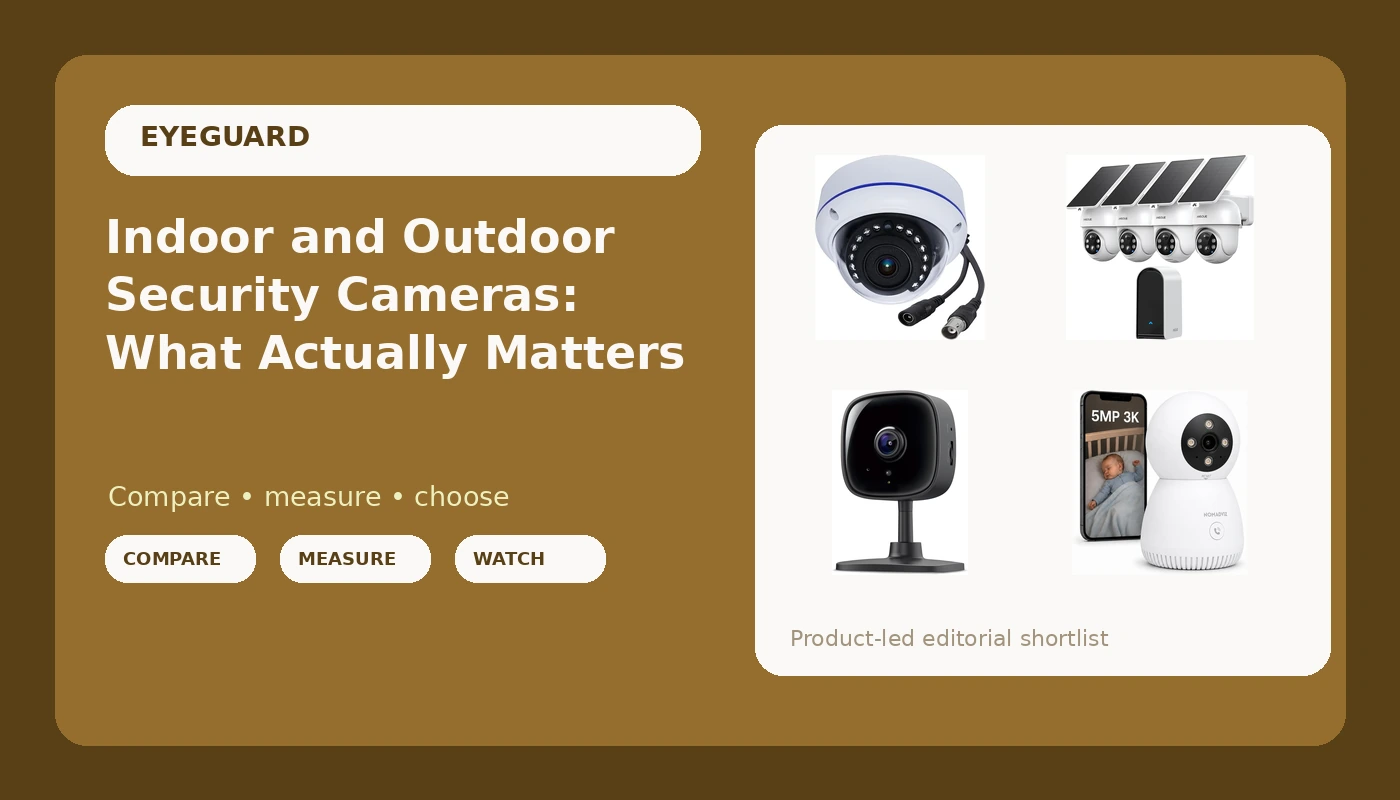
Most break-in footage fails in the same way. The camera wakes up, records twenty-something minutes of a dark shape moving across a driveway, and never captures a face anyone could identify. The clip goes to a detective, the detective shrugs, and the insurance claim gets denied for lack of evidence. Shopping for indoor and outdoor security cameras usually starts with resolution numbers and "crystal clear night vision" marketing, and those numbers describe what a sensor can capture, not what a clip can prove. Three questions decide whether a camera is actually useful: can it capture an identifiable face at the distance where a person approaches your door, what does it really cost over three years once the hardware is paid for, and where does the footage live when someone asks for it. Four very different cameras answer those questions in four different ways.
Related: Night Face ID Range: How Far a Security Camera Can Really Identify Someone →
Quick answer
These four cameras are built for different jobs, and matching the camera to the job matters more than any spec sheet. A wired coax dome gives you one wide fixed view with infrared night vision and no cloud dependency. A solar four-camera kit covers several outdoor angles without running power cable. A 5MP indoor camera with a call button is for checking in on a pet or a child. A compact 1080p indoor camera is the inexpensive way to watch a single room. None of them is a complete security plan on its own, so identify the job you actually have, then budget for storage and for whatever the app charges to keep recordings.
Four useful options
| Model | Best fit | What stands out |
|---|---|---|
| HD 1080P 2MP 180 Degree Fisheye Dome Security Camera | Wide, fixed coverage on a wired recorder | 180 degree fisheye view, 1.7mm lens, IR night vision, 4 in 1 TVI/AHD/CVI/BNC output |
| ANSQUE Home Security Cameras Wireless Outdoor, Solar Powered, 4-Cam System | Multiple outdoor angles without cable runs | Four wireless solar cameras in one kit |
| 5MP 3K Indoor Camera with One-Touch Call for Pet & Baby Monitor | Checking in on a pet, a child, or a room | 5MP 3K sensor plus a one-touch call button |
| Tapo 1080P Indoor Security Camera, Baby Monitor, Dog Camera, C101 | One room at a low hardware cost | Compact 1080p indoor camera |
Wide-angle wired dome: HD 1080P 2MP 180 Degree Fisheye Dome Security Camera
The fisheye dome is the odd one in this group, and that is the point. It is an analog camera, not a Wi-Fi gadget: it outputs TVI, AHD, CVI, or plain BNC video, which means it works with a DVR you already own or one you buy separately. The 1.7mm lens covers 180 degrees, so a single mount can watch a garage apron, a side gate, and the driveway approach at the same time, and the IR illuminators handle low light. The trade-off is distance. Wide coverage spreads the same sensor across a much larger area, so a face at the far edge of that 180 degree arc occupies very few pixels, and fisheye distortion bends the frame at the corners. Mount it low and close to the approach path rather than high on a wall, and a wired run back to a recorder gives you footage that lives in your house instead of a vendor account.
Solar four-camera system: ANSQUE Home Security Cameras Wireless Outdoor, Solar Powered, 4-Cam System
The case for a solar wireless kit is installation. There is no power cable to run and no video cable to pull, so four cameras can go up on a fence line, a shed, and two corners of the house in an afternoon. Solar panels mean you are not climbing a ladder every few weeks to recharge batteries, which is the failure mode that quietly kills most wireless setups: they get installed, then slowly go dark. The trade-offs are real too. Solar charging depends on how much direct sun each panel gets, and a shaded mount will struggle through a Northwest winter. Wireless video depends on Wi-Fi strength at the mounting point rather than at the router, so test signal where the camera will actually sit. Check what the app charges for recordings as well, because multi-camera kits often store clips in the cloud by default.
Indoor call button: 5MP 3K Indoor Camera with One-Touch Call for Pet & Baby Monitor
Indoor cameras are usually bought for a different reason than outdoor ones: checking on a pet, a baby, or an aging parent. That changes what matters. A 5MP 3K sensor gives you more detail when you want to see whether the dog got into something, or whether a child is genuinely asleep, and the one-touch call button turns the camera into an intercom so someone at home can reach you without hunting for a phone. The trade-off is that a high-resolution indoor camera is still an indoor camera. It is watching a room with people in it, so look for a clear privacy story before you mount it, whether that is a physical shutter, an obvious recording indicator, or a plug you can pull without disrupting anything else. Check what the app requires for storage before you buy.
Compact indoor camera: Tapo 1080P Indoor Security Camera, Baby Monitor, Dog Camera, C101
The compact 1080p indoor camera is the cheapest way into this category, and for a single room it is often enough. 1080p identifies a face at conversational distance indoors in decent light, which is what a baby monitor, a dog camera, or a quick look at the front hallway actually needs. What it will not do is tell you anything useful about a person standing at the end of a dark driveway. Treat it as a room camera and it does its job; expect it to guard a property and you will be disappointed. Before buying, check two things in the listing: whether local storage is supported, and whether you can replay footage saved locally without an active subscription.
Prices and availability may change. Product images, names, and retailer links must be matched by verified ASIN. Do not state a current price, rating, stock status, or measured result without current evidence.
What night vision claims leave out
Every camera box says night vision. Almost none of them tell you the part that matters, which is the distance at which the infrared image is still sharp enough to identify a person rather than simply detect one.
Infrared night vision works by lighting the scene with illumination you cannot see, and the camera records in black and white. The problem is spread. An IR array tries to reach everything within its range, and objects close to the lens get far more light than objects farther away. The result is IR washout: a gate, a wall, or a parked car near the camera blows out to white, while a person 25 feet back sits in murky gray that no amount of zoom can rescue. Motion blur compounds it. At night many cameras drop their shutter speed to gather more light, so anyone walking at a normal pace smears across the frame.
The useful measure is night identification range, the distance at which a face is clear enough to hand to someone else. It is not a spec you will find on a box, because it depends on lens width, sensor size, IR placement, and the geometry of your yard. A camera mounted eight feet up looking down a driveway can capture a face at the door; the same camera mounted twenty feet up looking at the same spot captures the top of a head.
Detail matters more than resolution here. A 1080p sensor with a tighter field of view can outperform a higher-resolution sensor behind an ultra-wide lens, because identification depends on how many pixels land on the face, not how many land on the frame.
Where your footage lives
Storage is the part of the purchase nobody thinks about until they need a clip they cannot download.
There are three common arrangements. Cloud storage uploads clips to a vendor's servers and usually comes with a monthly plan, a retention window, and rules about how long clips survive and whether you can export them. Local storage writes to a memory card or a recorder inside your house, which keeps working when the internet does not and does not depend on a company's continued goodwill. Hybrid setups do both, with the cloud as convenience and the card as the record of last resort.
Subscription math is where budgets break. A camera that costs little and charges a monthly fee is not a cheap camera. Multiply the plan by 36 months and put that number next to the hardware price before deciding anything; a more expensive camera with local storage is frequently the cheaper purchase by year two. Read the fine print on what happens if you stop paying, too. Some cameras will still record to a card but refuse to let you replay it without an active plan, which is a strange arrangement for footage that never left your house.
Finally, ask where the footage physically is. Local storage means your recordings sit on hardware you control, which is both a privacy argument and a practical one: nobody else's legal request quietly removes your copy.
- Decide what the camera is for: a face at the door, a room, a pet, or a perimeter.
- Measure the distance from the mount to the spot where identification matters most, and choose a lens width that still puts enough pixels on a face at that distance.
- Choose the storage model first, whether local card, recorder, or cloud, and note what the app charges for it.
- Compute the three-year cost: hardware plus every month of subscription you would actually need.
- Check the install before checkout: power, cable, signal, sun exposure, and whether you are willing to climb a ladder.
Before you mount anything
- Mount low and close to the approach path. A camera looking down at the top of a head is a motion detector, not a witness.
- Test Wi-Fi signal at the mount itself, not in the room below it.
- Keep reflective surfaces such as car paint, gutters, and white fences out of the IR field so nearby objects do not blow out.
- Write down a retention plan before the first alert: what happens if the card fills, the plan lapses, or the recorder dies.
- If the camera supports person detection, turn it on and tighten the zones, then check after a week how many of your alerts were actually people.
Which option should you choose?
Choose the HD 1080P 2MP 180 Degree Fisheye Dome Security Camera when you already own or plan to buy a DVR, you want one wide fixed view of a driveway or side yard, and you would rather not depend on Wi-Fi or a cloud plan. Choose the ANSQUE Home Security Cameras Wireless Outdoor, Solar Powered, 4-Cam System when you need several outdoor angles and running power or cable to each one is not practical. Choose the 5MP 3K Indoor Camera with One-Touch Call for Pet & Baby Monitor when the job is checking in on a pet or a child and you want a call button plus more detail in the frame. Choose the Tapo 1080P Indoor Security Camera, Baby Monitor, Dog Camera, C101 when you want one room covered at the lowest hardware cost and you accept that it is a room camera, not a property camera.
One caveat applies to all four. The specifications here describe what each camera is built to do, not how it will perform in your yard. Night identification range, false alert rates, and subscription terms all depend on placement, lighting, weather, and the app's current policies, and those are the things worth verifying in the listing and the recent reviews before you buy. Field of view and distance to the subject decide more outcomes than any number printed on a box.
The bottom line
Security cameras rarely fail because they lack resolution. They fail because they are pointed the wrong way, mounted too high, starved of light, or locked behind a subscription the owner stopped paying. Start with the distance and the light at the spot that matters, choose the camera whose lens and storage model fit that spot, and do the three-year math before checkout. The wired dome and the solar kit handle the outside, with different trade-offs in cabling and sunlight. The two indoor cameras handle the inside, with different trade-offs in detail and cost. The camera that gets installed and aimed correctly beats the one that stays in the box, every time.