Most people buy their first camera the week after something goes missing, and most of them buy the wrong thing for the wrong spot. A single camera pointed at a driveway records a shape. It does not record a face. That gap between recording and identifying is the entire difference between footage the police can use and footage that gets watched once, sighed over, and closed. A home security camera setup is not a box you mount and forget. It is a set of coverage decisions: which approach routes matter, where a face is actually visible at night, and where your footage physically lives after the clip ends.
Related: Night Identification Range: How Far Your Camera Can Actually See →
Quick answer
Match each camera to a specific job instead of trying to cover a whole property with one unit. A solar multi-camera kit handles perimeter and yard coverage, a garage-specific camera handles the interior of the most common break-in entry point, a dedicated indoor monitor handles a room where you want continuous eyes, and a doorbell mount protects the camera that faces the street. Before buying anything, confirm the stated resolution, the night vision type, the storage options, and whether the features you actually want require a subscription. Check current Amazon price on each listing rather than trusting a number you saw in a deals email last month.
Four useful options
| Model | Best fit | What stands out |
|---|---|---|
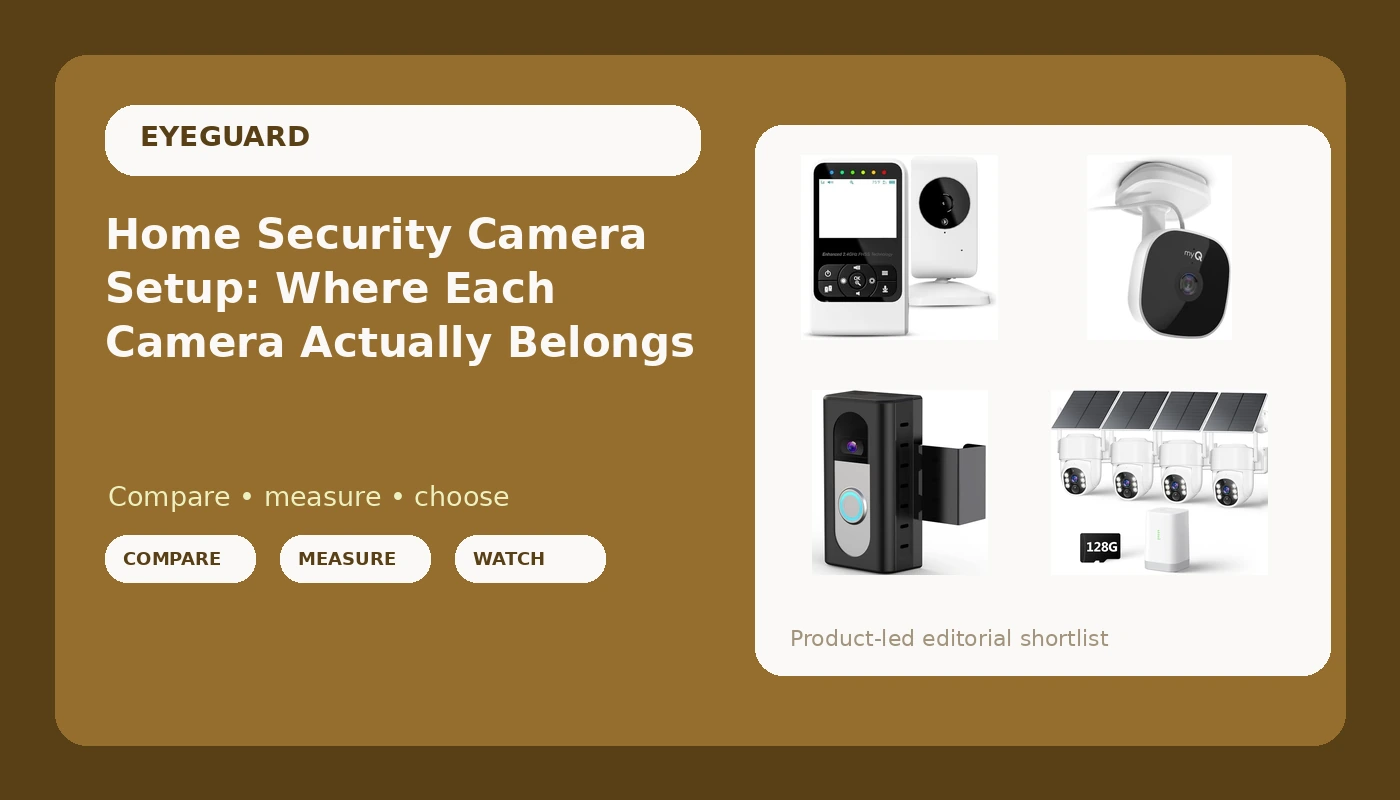
| 4MP Security Cameras Wireless Outdoor, No Subscription 128GB Local Storage, Solar Powered Cameras For Home Security, PTZ Auto Tracking, 4Cam-Kit, Color Night Vision Home Security Camera System,5G&2.4G | Whole-property perimeter coverage | Four 4MP cameras on one kit, solar powered, PTZ auto tracking, color night vision, 128GB local storage with no subscription, 5G and 2.4G Wi-Fi |
| myQ Smart Garage Security Camera, 1080p HD Video, Night Vision, Motion Detection, Magnetic, Wi-Fi, Two-Way Audio, Smartphone Control | The garage interior | 1080p HD video, night vision, motion detection, magnetic mounting, Wi-Fi, two-way audio, smartphone control |
| Babysense Video Baby Monitor with Camera and Audio, Long Range, Room Temperature, Infrared Night Vision, Two Way Talk Back, Lullabies and High Capacity Battery | A room you want watched continuously | Long range, room temperature readout, infrared night vision, two-way talk back, lullabies, high capacity battery |
| KIMILAR Anti-Theft Ring/Blink Doorbell Mount(NOT for Ring/Blink 2026 Rel) | Protecting a doorbell camera | Anti-theft mounting bracket for Ring and Blink doorbells, with the listing noting it does not fit the 2026 releases |
The perimeter kit: 4MP Security Cameras Wireless Outdoor, No Subscription 128GB Local Storage, Solar Powered Cameras For Home Security, PTZ Auto Tracking, 4Cam-Kit, Color Night Vision Home Security Camera System,5G&2.4G
The trade-off with a kit like this is that you are committing to one ecosystem and to four mounting locations at once. Pan and tilt tracking is useful for covering a wide yard, but a camera that physically moves can also be mid-swing when the thing you care about walks past. Local storage keeps your footage in your house and out of a vendor's retention policy, which is the arrangement I would want, but it also means the recording is only as durable as the card or drive inside the unit. Solar power removes the chore of climbing a ladder to charge batteries, with the obvious caveat that a shaded mounting spot will not produce the same results as a sunny one.
The garage camera: myQ Smart Garage Security Camera, 1080p HD Video, Night Vision, Motion Detection, Magnetic, Wi-Fi, Two-Way Audio, Smartphone Control
Garage coverage is underrated because the garage is often the softest target on the property: a side door, a window, and a lot of valuables, with no neighbor looking straight into it. The catch is that a magnetic mount can be knocked loose by the same person you are recording, and an indoor camera is not built to be rained on, so it belongs inside the door rather than above it. Point it at the interior side of the entry point rather than at the parked car, because a face walking in is worth more than a license plate you already own.
The indoor monitor: Babysense Video Baby Monitor with Camera and Audio, Long Range, Room Temperature, Infrared Night Vision, Two Way Talk Back, Lullabies and High Capacity Battery
Not every camera in a house should be an internet camera. A dedicated monitor keeps a nursery feed on a closed link between the camera and its parent unit, which sidesteps the whole question of who else can reach that stream. The trade-off is real: you cannot check it from a hotel, you cannot hand a clip to a detective, and you get one screen instead of unlimited viewers. If your goal is protecting a room rather than documenting a crime, that is a reasonable swap to make deliberately.
The doorbell mount: KIMILAR Anti-Theft Ring/Blink Doorbell Mount(NOT for Ring/Blink 2026 Rel)
A doorbell camera has a structural weakness that no amount of resolution fixes: it sits at arm's reach, and it is usually held on by a bracket a stranger can defeat in under a minute. An anti-theft mount does not make the camera better, it makes the camera stay. Read the compatibility note carefully, because this listing explicitly excludes the 2026 Ring and Blink releases, and a mount that does not fit is a return, not a deterrent.
Prices and availability may change. Product images, names, and retailer links are matched to verified listings. No current price, rating, stock status, or measured result is stated here without current evidence.
Why night identification range decides everything
Every camera box advertises night vision. Very few listings tell you the distance at which that night vision still resolves a face you could hand to an investigator. Those are two different numbers, and the gap between them is where security budgets go to die.
Infrared illumination has a falloff problem. A camera pushing IR hard enough to reach the back fence will often overexpose anything standing within a few feet of the lens, blowing out a face into a white smear. The reverse is just as common: a camera that renders nearby objects cleanly but leaves a figure at the end of the driveway as an unidentifiable silhouette. Neither failure is obvious in daylight, which is when most people install and check their cameras.
The practical consequence is that placement beats specification. A camera mounted at face height near the point of entry, angled across the approach path rather than down at the ground, will out-identify a higher-resolution camera mounted under the eaves pointing at a driveway. A steep downward angle gives you the top of a hood and a patch of pavement. A shallow angle across the walking path gives you a profile, which is what actually gets matched.
Person detection matters here too, and it is the feature most likely to be oversold. Onboard AI that filters motion down to humans is only as good as its nighttime performance, and a camera that flags every passing car, shadow, and raccoon is a camera people eventually mute. A muted camera records nothing you will ever review, so false alert volume is not a quirk. It is a failure of the setup.
Where your footage lives, and who else can reach it
Storage is the second decision, and it is usually made by accident. Cloud plans are convenient, they survive a camera being stolen or smashed, and they are also a recurring cost with a retention window you did not choose and a set of legal requests you do not control. Local storage on a card or a recorder keeps footage inside the house, costs nothing monthly, and disappears entirely if the device itself walks away.
The honest version of this trade-off is that most serious setups use both. Local storage as the primary copy, because it is yours and it is free after purchase, and a cloud or offsite copy for the clips that matter, because a thief who takes the camera also takes the card. The mistake is paying for hardware marketed as subscription-free and then discovering that the feature you actually wanted, like reviewing footage or exporting a clip, is gated behind a plan.
Before buying, price three years of ownership, not the sticker on the box. Hardware plus any required subscription plus the cost of the storage media. That number is the real price of the camera, and it is the only one worth comparing.
Planning the setup before you drill anything
- Walk your property at night and list the routes a person would actually take to reach a door, a window, or a parked car.
- Assign one camera to each decision point, prioritizing the entry you would least want someone to reach unnoticed.
- Choose mounting heights that put the lens near face level along the approach, not tucked under the roofline looking down.
- Decide where footage will live before you buy, and confirm whether the features you want require a subscription.
- After mounting, test at night with a person walking the path at roughly 10, 20, and 30 feet, and check whether you can identify them in the clip.
Practical guidance that saves a return
- Aim for overlap, not coverage. Two cameras with a shared field of view at the critical door beat four cameras with gaps between them.
- Put the perimeter kit on the yard and driveway, the garage camera inside the garage door, and a monitor inside the room, because each device is built for its environment.
- Set detection zones tightly on day one. Broad zones are how notifications get muted within a week.
- Verify Wi-Fi strength at each mounting location before committing, since 5G and 2.4G support only helps if the signal reaches the spot.
- Confirm the compatibility note on any mount or bracket. The anti-theft doorbell mount here excludes the 2026 Ring and Blink releases, and similar exclusions are easy to miss.
Which option should you choose?
Choose the 4MP Security Cameras Wireless Outdoor, No Subscription 128GB Local Storage, Solar Powered Cameras For Home Security, PTZ Auto Tracking, 4Cam-Kit, Color Night Vision Home Security Camera System,5G&2.4G when you need multiple outdoor angles at once, want solar power instead of battery swaps, and prefer local recording without a recurring fee. Choose the myQ Smart Garage Security Camera, 1080p HD Video, Night Vision, Motion Detection, Magnetic, Wi-Fi, Two-Way Audio, Smartphone Control when the garage interior is your weak point and you want a magnetic, repositionable camera with two-way audio. Choose the Babysense Video Baby Monitor with Camera and Audio, Long Range, Room Temperature, Infrared Night Vision, Two Way Talk Back, Lullabies and High Capacity Battery when you want a room watched continuously on a dedicated screen rather than through an app. Choose the KIMILAR Anti-Theft Ring/Blink Doorbell Mount(NOT for Ring/Blink 2026 Rel) when you already own a compatible Ring or Blink doorbell and want it to stay mounted.
One caveat applies across all four: these are different tools with different jobs, and the listing details, including resolution, storage terms, and compatibility, are the only specifications stated here. Verify fit and features on the product page before ordering, particularly the doorbell mount's stated exclusion for the 2026 Ring and Blink releases.
The bottom line
A camera is only security if it can produce a face, and it is only useful if the footage survives in a place you control. Build the setup around the routes someone would actually walk, mount for identification rather than for a wide view, decide your storage before you buy, and count the subscription into the price. The garage kit, the interior garage camera, the room monitor, and the doorbell mount each solve a different piece of that puzzle, and a setup that covers the approach, the entry, and the room behind it will outperform a single expensive camera mounted in the wrong place every time.