Related: Night Vision Face ID Range: What 2K Resolution Actually Buys You
The camera was already mounted when someone pried open the side door of my garage at 3:07 in the morning. It recorded 22 minutes of a raccoon and one dark shape that never turned into a face. The detective was polite about it. No face, no case. Insurance watched the same clip and denied most of the claim.
I have been testing cameras on my own garage and back fence ever since, logging every alert in a notebook I call The Garage Log, and I now field the "which camera should I buy" question from the entire neighborhood watch group. This page is the answer I give, organized around four wireless outdoor security cameras that solve four different problems. One is a five-camera system. One is a four-camera kit. One runs on solar. One never touches your siding at all.
None of them is right for every house. All four are worth understanding before you spend anything.
The whole-house system: Blink Outdoor 2K+ with Sync Module Core
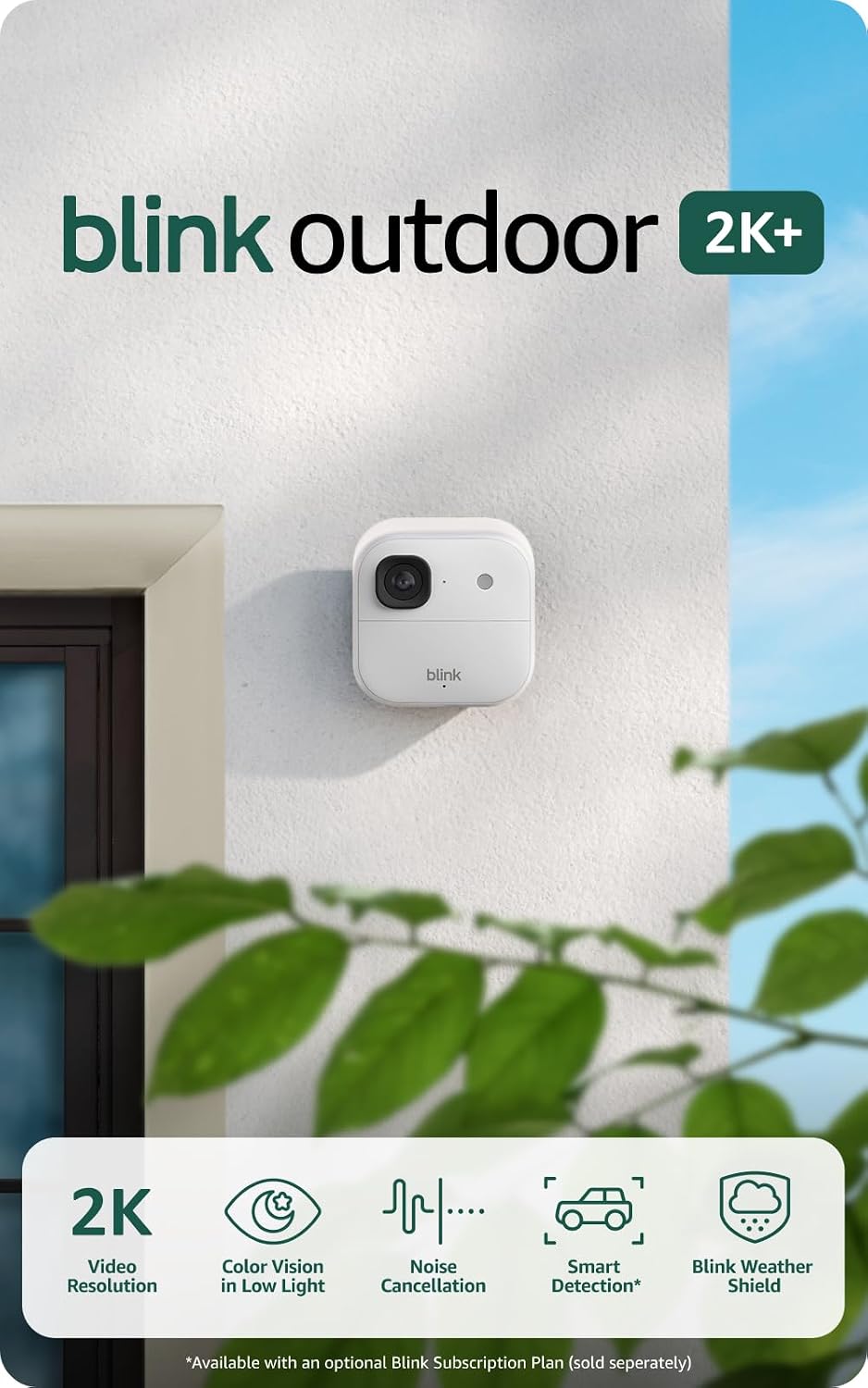
The Blink Outdoor 2K+ bundle is what I would hand to someone who wants the job finished in one weekend. Five cameras, one Sync Module Core, 2K video on every one of them, enhanced audio, and a two-year battery rating that is the difference between a camera you maintain and a camera you forget about.
Five cameras is the number that matters. Most people buy one camera, point it at the driveway, and call it security. That is exactly how you end up with 22 minutes of a raccoon. Coverage is the product here: front door, side gate, driveway, back slider, garage. Five angles is roughly where a normal suburban lot stops having blind spots.
The Sync Module Core is the part I would read the listing for before buying. It is the hub that ties the five cameras together, and it is the piece that decides where your footage lives. Cloud storage on a system like this means a subscription, and a subscription means the hardware is the down payment, not the price. Local storage means the clip of the person who actually opened your door is still sitting in your house when a detective asks for it. Check what the module supports, because that single question changes your three-year cost more than the sticker price does.
Two-year battery is the other thing to weigh. That is genuinely good for a wireless camera, and it still means a ladder eventually.
The four-camera kit: GMK 4 Pack Security Cameras Wireless Outdoor
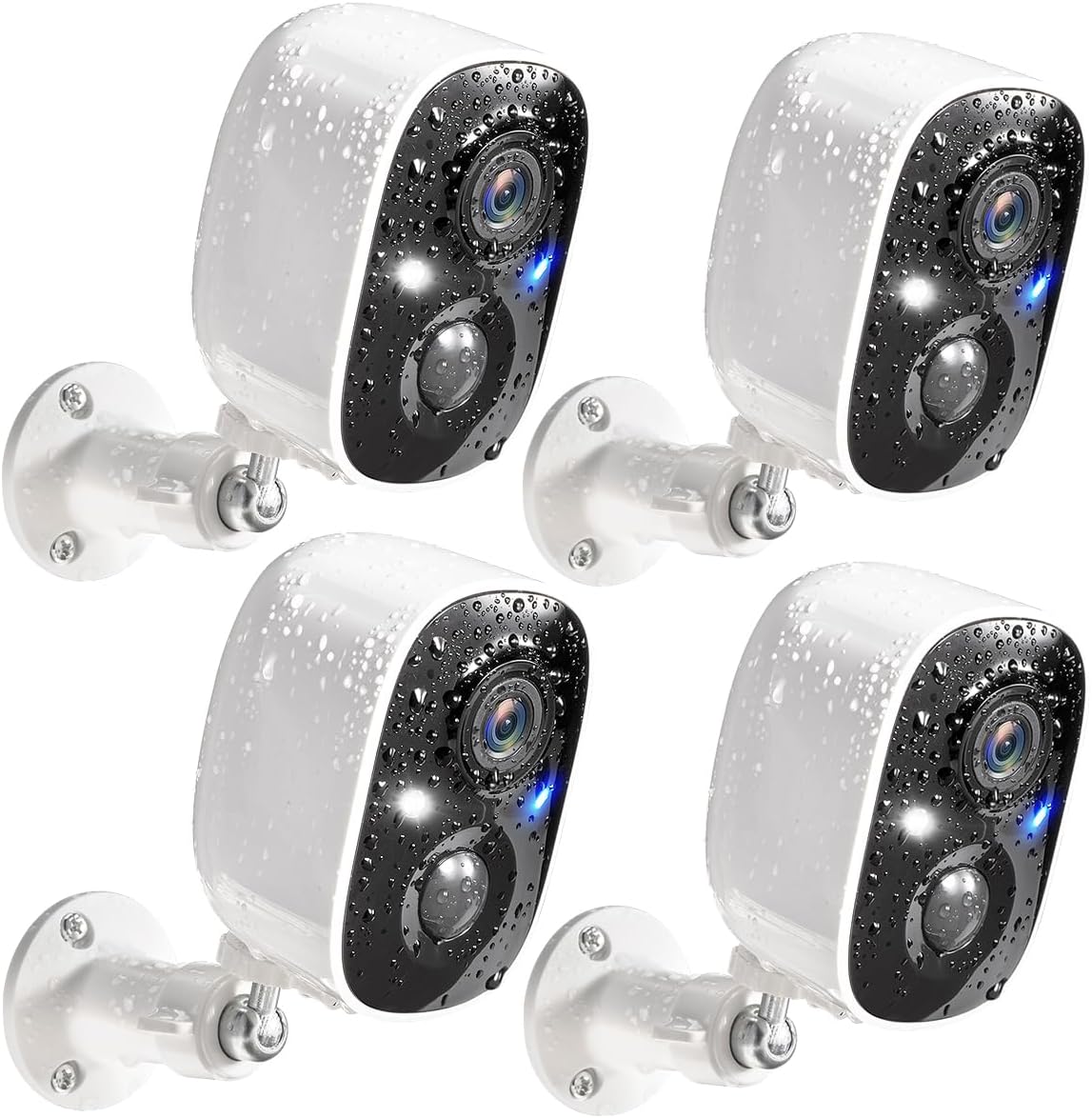
If the goal is perimeter coverage and the budget is the constraint, the GMK four-pack is the straightforward answer. Four wireless outdoor cameras, 2K video, one purchase. You are covering four sides of a house instead of arguing with yourself about which single wall gets the best view.
The honest trade is that a four-pack spreads your money across four units, so each camera is simpler than a single premium model. That is usually the right trade for a house. Four decent angles beat one excellent angle almost every time, because intruders do not walk into your best camera on purpose.
What a four-pack really costs is installation time. Four mounts, four power decisions, four Wi-Fi connections to verify. Budget an afternoon, and budget it before you buy, not on the Saturday you had planned for something else. My rule from The Garage Log: the best camera is the one that is actually mounted. A four-pack still in the box is worth exactly nothing.
The solar one: GALAYOU Solar Camera Outdoor Wireless, R6
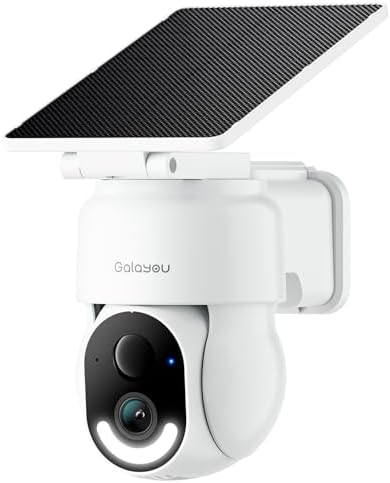
The GALAYOU R6 answers the single most annoying thing about wireless cameras: charging them. A small solar panel on the camera means the battery tops itself up through the day, and you stop planning your month around a ladder.
One camera, 2.4GHz Wi-Fi. That single-band radio is a feature at the edge of a property, not a flaw. The 2.4GHz band is the one that still reaches the back fence through walls, long after the 5GHz band from your router gave up two rooms ago. If your camera is mounted 60 feet from the house, that is the band you want.
This is also the camera I would use to test a solar setup before committing to a whole array of them. Buy one, mount it where you would actually put a camera, and watch what the battery does through a week of gray Seattle weather. If it holds, buy more. If it does not, you learned that for the price of one camera instead of four.
The no-drill option: JOOAN 2K Window Camera
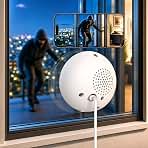
Renters have the worst options in this entire category, and the JOOAN window camera is the one that fixes that. It sits inside the glass and looks out. No drilling, no ladder, no landlord conversation, and no battery to charge because it lives indoors on a normal outlet.
It shoots 2K with night vision, and it handles both 5GHz and 2.4GHz Wi-Fi, which makes it easy to place near a router. The feature that decides whether you should buy it is the anti-glare treatment. Every window camera fights the same physics problem: infrared light leaves the camera, hits the glass, and bounces straight back into the lens, which is how you get a bright fog with a vague shape somewhere behind it. Anti-glare is the fix, and it is what I would judge this camera on, not the resolution number.
Window cameras also lose a little sharpness shooting through glass, especially at night and especially if the pane is dirty. Clean the inside of that window the day you mount it. It sounds like a joke. It is not.
How I evaluate a camera before it goes on my fence
Four questions, every time.
Can it identify a face at 20 feet at night, or does it only detect motion? Detection is not identification. A motion alert tells you something happened. A face tells you who.
What does it cost over three years, subscription included? The hardware is the down payment. The subscription is the price. Any camera that cannot replay the footage on its own storage without a monthly fee is a rental.
Where does the footage live, and who else can see it? Local storage means your clips stay in your house and nobody else's legal request quietly removes them.
Would I hand that clip to a detective and expect an arrest? If the answer is no, the camera is decoration with a blinking LED.
What actually decides a night clip
Resolution is the number printed on the box. Infrared is what decides whether that resolution is worth anything after dark. A 2K sensor is a real upgrade over 1080p, and it stops mattering the moment the IR illuminator blows out everything within 15 feet while trying to reach 50. That is IR washout, the blurry raccoon effect, and it is why two cameras with identical resolution can produce wildly different footage.
Person detection is the second thing. It filters motion alerts down to actual humans, which is the difference between a camera you trust and a camera you mute. A camera everyone mutes is not a security system. It is an LED.
The third thing is power. Battery means a ladder. Solar means fewer trips up that ladder. Indoor outlet or wired means none. Pick the power source you will actually maintain, because the perfect camera with a dead battery records nothing at all.
And read the storage terms before the specs. "Free cloud storage" usually means a short rolling window of clips you cannot export, which is the worst possible version of both worlds.
Wireless outdoor security camera comparison
| Camera | Best for | Video | Power | Cameras in the box | Price |
|---|---|---|---|---|---|
 Visit on Amazon → Visit on Amazon →Blink Outdoor 2K+ system |
Whole-house coverage in one box | 2K | Two-year battery | 5 plus Sync Module Core | $119.99 |
 Visit on Amazon → Visit on Amazon →GMK 4 Pack system |
Four sides of a house on a budget | 2K | See listing | 4 | $99.99 |
 Visit on Amazon → Visit on Amazon →GALAYOU R6 solar camera |
Set-and-forget at the fence line | See listing | Solar | 1 | $29.99 |
 Visit on Amazon → Visit on Amazon →JOOAN window camera |
Renters and no-drill installs | 2K | Indoor outlet | 1 | $26.99 |
Should you buy the Blink Outdoor 2K+ system?
Yes, if you want one purchase to cover a whole house. Five cameras and a Sync Module Core in a single box is the shortest path from "I should get cameras" to "the garage is covered," and the two-year battery rating means you are not thinking about charging for a long while.
Read the storage details first, because the module is what decides whether this becomes a subscription or a local setup. That is true of every camera on this page, and it matters most on the system with the most cameras. If you want the hardware to be the whole cost, verify that before you buy.
Should you buy the GMK 4 Pack?
Yes, if four angles matter more to you than one fancy camera. This is the budget-per-side-of-the-house play, and for most homes it is the correct one. Two things to accept going in: 2K is the ceiling, and four cameras mean four installs.
If you are not going to mount all four, do not buy four. Buy the one that covers your worst blind spot and add from there. Half a kit installed beats a full kit in the closet.
Should you buy the GALAYOU R6?
Yes, if you hate ladders. Solar charging removes the maintenance chore that kills wireless camera setups, and the 2.4GHz radio is the right choice for a camera parked at the far edge of your property. Buy one, live with it through a cloudy week, then decide about the rest.
Do not buy it expecting a premium sensor. It is a single-camera solar unit, and it is priced like one.
Should you buy the JOOAN window camera?
Yes, if you rent or you refuse to put holes in your siding. It is the only camera here that needs no mounting hardware and no outdoor power, and 2K with night vision is a reasonable spec for looking out at a driveway or a street.
Judge it on the anti-glare performance, and keep that glass clean. If you can drill and you own the place, the Blink system or the GMK four-pack will give you better angles. If you cannot, this is your camera.