Related: Security Camera Night Vision Range Explained
Well, here's a question: does your own security camera make you the one breaking the law? I've been testing cameras on my Seattle garage since February of last year, the month someone pried open my side door and walked off with two bikes and my dad's camping gear.
I've logged every false alert, every firmware brick, every frozen battery in a notebook I call The Garage Log.
And I can tell you this: most people mount their first camera with zero idea what the law actually allows.
I've been there. Here's what I've learned the hard way, plus the books that actually helped me sort it out.
| Product | Price | Why it won | Why it lost |
|---|
The law is simpler than you think, and messier than you'd hope
Here's the part nobody puts on the marketing page. In most of the US, you can record video on your own property without telling anyone. That's the good news. The bad news is that audio is a different animal. Eight states require two-party consent for audio recording, and that includes your doorbell cam's microphone picking up a conversation through an open window.
I learned this from a neighbor in my watch group. He mounted a camera over his driveway, pointed it at the street, and recorded audio of a couple arguing on the sidewalk. He posted the clip to our group chat. Turns out, in Washington state, that's a wiretap violation. He was lucky nobody pursued it.
The rule I now live by: point cameras at your own property, avoid recording audio where people have a reasonable expectation of privacy, and never post footage of someone else's private activity. That's the whole ballgame.
A Short & Happy Guide to Privacy and Cybersecurity Law (1684679834)
I'll be honest, I bought this one because it was $30 and short enough to actually finish. It's the only book on this list that I read cover to cover in one weekend, which is saying something for a law book. It's written for law students, but it reads like a very dry conversation with a smart friend who happens to know the rules.
The chapters on video surveillance and expectation of privacy are exactly what I needed after the neighbor incident. It walks through the legal framework without pretending there's one clean answer for every scenario. The "happy" in the title is doing a lot of work, but the book is genuinely accessible.
What I found most useful: the section on how courts have ruled on cameras pointed at public spaces versus private ones. It gave me the language to explain to my watch group why we can film the street but not our neighbor's backyard. That alone was worth the $30.
Choose this one if you want the actual legal reasoning, not just a list of do's and don'ts. If you're the kind of person who likes to understand why the rule exists, this is your book.
Camera Power: Proof, Policing, Privacy, and Audiovisual Big Data (1108418554)
This one is the heavy hitter, and I mean heavy in every sense. At $49.99, it's the most expensive book on this list, and it's an academic work through and through. I bought it after the Ring police-access story broke, because I wanted to understand how my footage could be used against me.
The book is a deep dive into how camera footage functions as evidence, how police access works, and how the rise of cheap cameras has changed what "privacy" even means. It's not a practical guide. It's a political and legal analysis of the entire surveillance ecosystem. There were chapters I had to read twice.
But here's why I'm recommending it despite the price and the prose: it's the only book I've found that takes the home security camera boom seriously as a legal phenomenon. It made me think about my own footage differently. I now know that my clips could be subpoenaed in a neighbor's divorce case, and that I should treat my microSD card like a document, not a toy.
Choose this one if you're a privacy nerd, a law student, or someone who wants to understand the system before you add another camera to your soffit. Skip it if you just want to know whether you can point a camera at your driveway. That answer is cheaper and shorter.
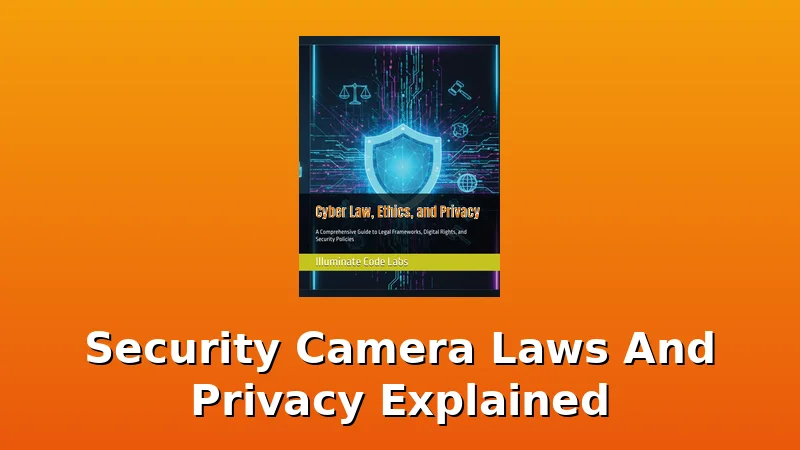
Cyber Law, Ethics, and Privacy: A complete Guide to Legal Framewo
At $8.90, this is the budget pick, and it shows. The production quality is what you'd expect at that price, and the title is a mouthful. But here's the thing: it's current, it's cheap, and it covers the basics without pretending to be the final word.
I picked this up to fill the gaps in my knowledge, particularly around data storage and what happens to your footage if a company goes bankrupt. The section on cloud data ownership is genuinely useful, especially if you're using a subscription camera that stores clips on someone else's server.
The downside is that it's not specific to home security cameras. It covers cybersecurity law broadly, which means the camera-specific scenarios I care about get a few paragraphs each. For the price, though, it's a solid primer. I'd hand this to a neighbor before I'd hand them the $50 academic book.
Choose this one if you're on a budget and want a general overview. It's not the book that will make you an expert, but it's the book that will keep you from making the dumb mistakes.
What the law actually means for your camera setup
Let me translate all this into what matters on your garage. Three rules I've settled on after reading these books and testing cameras for over a year:
First, your camera can watch your property, but it shouldn't watch your neighbor's windows, their backyard, or the public sidewalk beyond a reasonable field of view. I've adjusted three of my own cameras after realizing they were capturing more of the street than I needed.
Second, turn off the audio unless you're sure your state allows it. My Wyze cams have the microphone disabled. The 2K Eufy on my fence has audio off too. It's not worth the legal headache to hear a conversation you shouldn't be recording.
Third, know where your footage goes. If you're using a subscription camera, your clips live on someone else's server, and that means they're subject to subpoena, data breaches, and whatever the company decides to do with them. Local storage keeps the footage yours. That's why I'm still a local storage evangelist.
My honest bottom line
The law isn't as scary as the headlines suggest, but it's not as simple as the marketing pages pretend. Read the Short & Happy Guide if you want the cleanest overview, and pick up Camera Power if you want to understand the system. Then go adjust your camera angles and turn off your microphones. Your future self will thank you.