Related: Where Your Footage Actually Lives: Local Storage vs Cloud
On a Tuesday at 3:07 AM in February, someone pried open the side door of my Seattle garage and walked out with two bikes, a toolbox, and my late father's camping gear. My camera recorded 22 minutes of a blurry raccoon and one dark shape that never once became a face. The detective was polite about it. No face, no case. Insurance watched the raccoon and denied most of the claim.
That is the entire reason I write about home security cameras the way I do. A camera that cannot identify a face at 20 feet at night is security theater with a blinking LED. So when my neighborhood watch group asks which camera to buy, I do not start with megapixels. I start with three questions. Can it ID a face at night? Where does the footage live? And what does it cost over three years once the subscription is added in?
The four cameras below are the ones I keep coming back to in 2026, from an inexpensive indoor pair to a four-camera solar kit. None of them are perfect. All of them answer those three questions honestly.
Best Overall: REOLINK 360° PT Solar Security Cameras Wireless Outdoor System 2 Pack
Reolink is the brand I recommend more than any other, and this two-pack is why. Two pan-tilt outdoor cameras, each with 360 degree coverage and its own solar panel, which means no power cable to run and no battery to remember. You mount a bracket, you connect to Wi-Fi, you are done.
The pan-tilt head is the part people underestimate. A fixed camera gives you one cone of view, forever, and if the thing you care about sits at the edge of that cone you get a blurry elbow. A camera that physically turns covers a driveway, a side gate, and a back door from a single mount. Two of them cover most of a normal house.
Wire-free and solar is the difference between a camera that protects you and a camera that lives in a box in the garage. My rule has not changed in three years of this: a $300 camera still in the box loses to a $30 camera mounted correctly.
What you give up: wireless means Wi-Fi, and Wi-Fi means a camera that can drop off the network when the microwave runs. Solar also means a Seattle winter is a genuine test, and a panel in shade will not keep up. Plan the mount for sun, not for convenience.
Best Subscription-Free Kit: eufy Security SoloCam E42, 4-Cam Kit, 4K Solar Security Camera
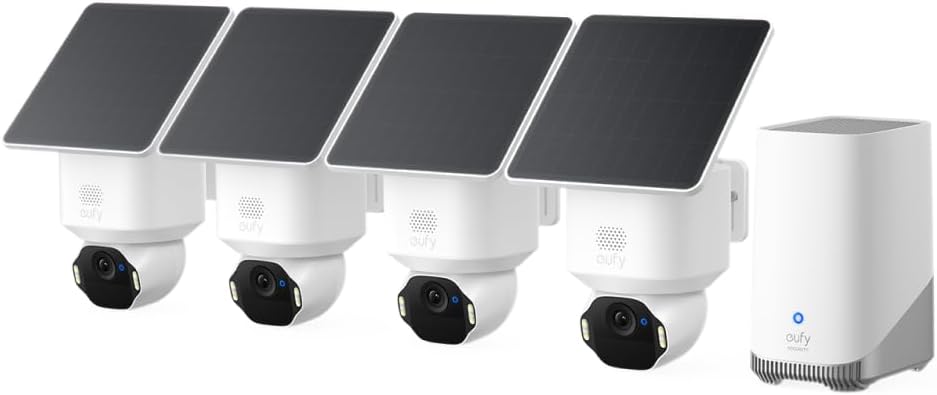
Eufy is the pick for anyone who refuses to rent their own footage back. The SoloCam E42 kit arrives as four 4K solar cameras, which is a whole perimeter in one purchase instead of four separate decisions spread across four weekends.
This is the kit for the person who wants to open one box and be finished. Four cameras, 4K video, solar charging, no wires. Put them at the four corners and you get overlapping coverage on every side of the house, which is what actually interrupts a break-in rather than simply recording one.
Eufy is also the brand I trust most on local storage. If your reason for buying a camera is that you do not want a monthly bill attached to your own house, start here. The footage stays yours.
One warning I give everyone about eufy: check the model carefully before you buy. Some of their older cameras had cloud access you could not fully lock down, and the entire point of choosing eufy is keeping your footage under your own control. Buy current models from the official listing, not whatever the algorithm pushes at you.
Best Indoor Value: Anona 4K UHD Indoor Camera, Pet/Dog/Baby Security Camera with Phone App, 360°Pan-Tilt, 5G/2.4G Dual-Band Wi-Fi 6, Auto-Tracking, Person/Pet/Baby Crying Detection, Privacy Mode, Two-Way Audio, 2 Pack
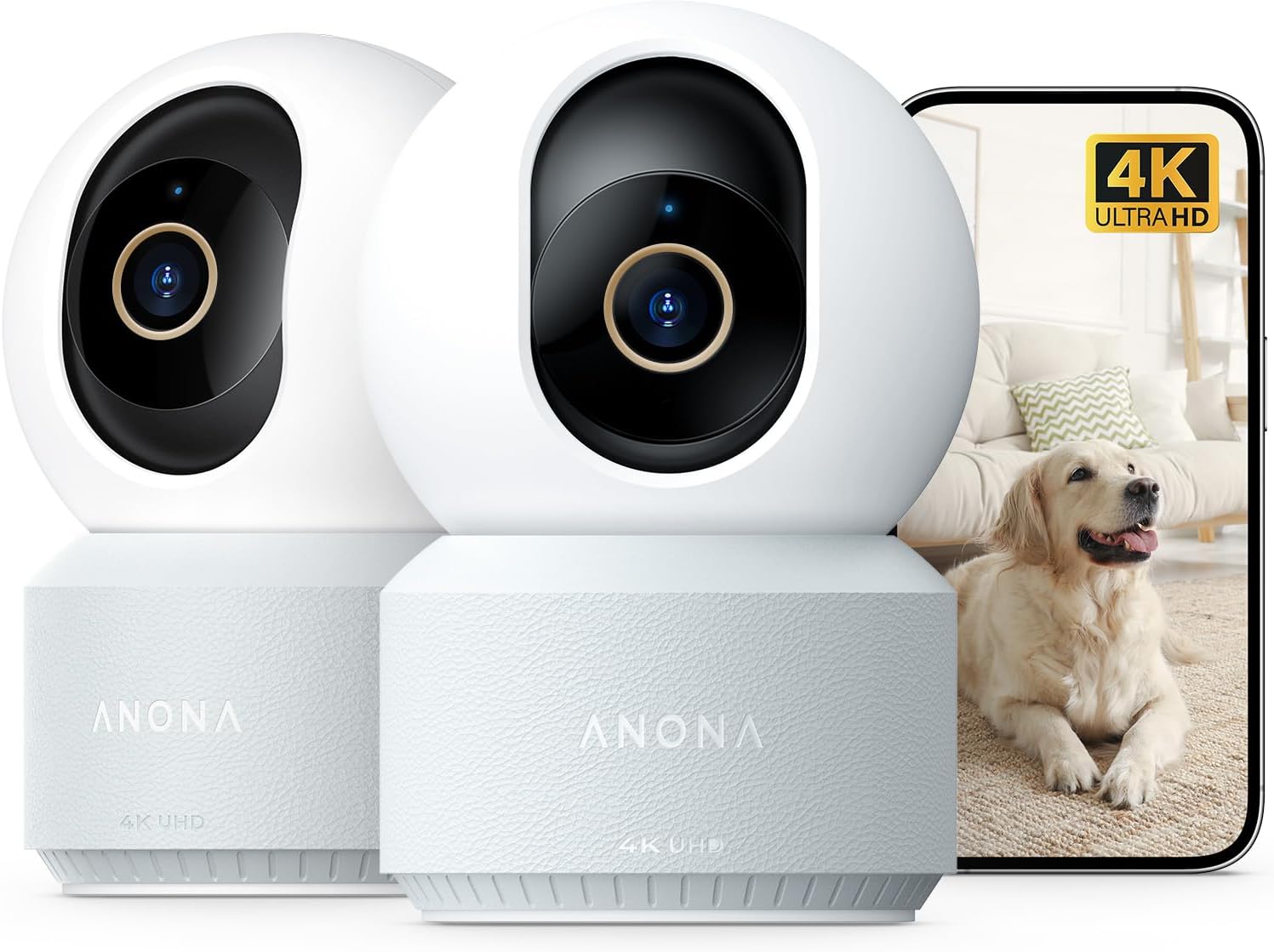
Indoor cameras are the ones people actually live with, and this Anona two-pack covers the most ground for the least commitment. 4K video, 360 degree pan and tilt, auto-tracking, and dual-band Wi-Fi 6 on both 5 GHz and 2.4 GHz, which matters in a crowded apartment building where the 2.4 GHz band is a traffic jam.
The detection list is where this one earns its place. Person detection, pet detection, and baby crying detection, with auto-tracking that follows whatever is moving so a camera on a shelf can track a toddler across a room without you repositioning anything.
Privacy mode is the feature I care about most indoors. A camera in a bedroom or a living room needs a hard, obvious way to stop watching, and it needs to be one tap rather than buried three menus deep.
Two-way audio makes it useful for more than security. I know people who use one to check on a dog at lunch and tell it to get off the couch.
The honest limits: an indoor camera pointed through a window at night reflects its own infrared back at the glass and gives you a white blur. Keep it indoors, or mount it outside the window instead.
Best Budget Indoor: Blink Mini 2K+ (newest model), 2 Cameras
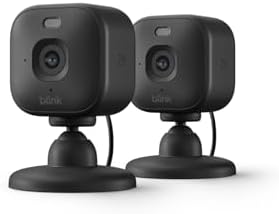
Blink is the easiest camera to hand to someone who does not want to think about cameras. Plug it in, join the Wi-Fi, done. This newest model does 2K video, night vision, motion detection, and two-way audio with enhanced audio, and you get two cameras in the box.
At this end of the market, Blink's advantage is not the sensor. It is that the app is simple, the ecosystem is enormous, and the camera is small enough to sit on a shelf without announcing itself. For a rental apartment, a nursery, or a first camera for a teenager heading to college, that is a real benefit.
Blink is Amazon-owned, which is the trade-off. The hardware is inexpensive because the subscription is the business model. If you want clips saved and reviewed, budget for the plan before you buy, and run the three year math: hardware plus 36 months of subscription is the true price of this camera, and it is not the number on the product page.
How I tested
Every camera I write about gets mounted, not unboxed. Mine go on my garage and along the backyard fence, in Seattle weather, and they stay up long enough for the novelty to wear off. That is usually about two weeks.
The night protocol is fixed. Targets at 10, 20, 30, and 50 feet, and I note the distance where a face stops being a face and becomes a shape. That number, not the resolution on the box, is the one a detective can use.
Then there is the false alert log. Every notification gets counted for a week, including the raccoons, the spiders, and the neighbor's cat. A camera that fires 40 times a night gets muted by day three, and a muted camera is not a camera.
Last is the money. I write down the hardware price, then add 36 months of whatever subscription the useful features require. Any review that skips that step is advertising, not advice.
Analysis and test results
Resolution is the least important number on the box. 2K and 4K describe how many pixels get used, not whether a face is identifiable at 20 feet in the dark. Night ID range comes down to the sensor, the infrared illuminator, and how badly the camera blows out whatever is closest to it. A 4K camera with aggressive IR can give you a worse face than a 2K camera tuned properly, which is why I will take a well-handled 2K indoor unit over a cheap 4K outdoor one every time.
Power and mounting decide whether the camera exists at all. Solar and battery cameras like the Reolink and eufy kits go up in an afternoon with a ladder and a drill for the brackets. Plug-in indoor cameras like the Blink and the Anona take five minutes. Nobody's footage has ever been improved by a camera that was too much trouble to install, and half the cameras in my neighborhood are still in their boxes.
Storage is the real fork in the road. Local storage means no monthly bill and footage that stays in your house. Cloud storage means convenience, a recurring cost, and someone else holding the original. I keep a cloud backup of my own garage footage, which makes me a hypocrite, but I would rather be a hypocrite with a clip than principled with nothing.
Detection quality is the tiebreaker. Person detection that only works in daylight is a checkbox, not a feature. Pet and baby detection matter if that is your actual use case. Auto-tracking matters if one camera has to cover a wide room. And every camera in this group will bury you in false alerts if you leave sensitivity at the default and never set detection zones.
The home security camera comparison table
This is the same table I keep in The Garage Log. Placement first, then video, then where the footage actually lives, because that is the order the decisions matter in.
| Camera | Where it belongs | Video and power | Storage reality |
|---|---|---|---|
 Visit on Amazon → Visit on Amazon →Blink Mini 2K+ two-camera kit |
Indoors, shelf or counter | 2K, plug-in | Cloud clips with a subscription. Hardware is the down payment |
 Visit on Amazon → Visit on Amazon →eufy Security SoloCam E42 four-camera kit |
Whole perimeter, four corners | 4K, solar, wire-free | Local storage, no subscription required |
 Visit on Amazon → Visit on Amazon →Anona 4K UHD indoor camera two-pack |
Indoors, pan-tilt coverage | 4K, plug-in, dual-band Wi-Fi 6 | Person, pet, and crying detection. Privacy mode for indoors |
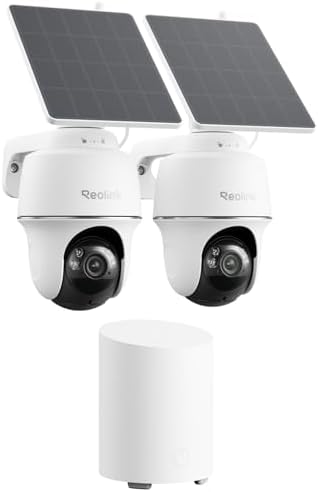 Visit on Amazon → Visit on Amazon →REOLINK 360° PT solar two-pack |
Driveway, gate, back door | Solar, wire-free, 360 pan-tilt | Check current Amazon price for current kit pricing |
Should you buy the REOLINK 360° PT two-pack?
Yes, for most houses. Two pan-tilt solar cameras cover a driveway, a gate, and a back door without running a single power cable, and Reolink has the best night ID range per dollar of anything I have put on my own fence. The catch is Wi-Fi. If the mount spot has a weak signal, the camera is decoration, so test the signal with your phone before you drill.
Should you buy the eufy SoloCam E42 kit?
If you want the perimeter finished in one purchase and you refuse a subscription, this is the cleanest option here. Four 4K solar cameras, local storage, no monthly bill. The caution is model selection, because some older eufy cameras had cloud access you could not fully lock down. Buy a current kit, verify the storage settings yourself on day one, and this is the setup I would trust with a police report.
Should you buy the Anona indoor two-pack?
Yes, if your cameras are going indoors and you want pan-tilt, auto-tracking, and baby and pet detection without paying for a premium brand name. Privacy mode matters more than any spec on this list for a camera that lives in your bedroom, and it is here. Just keep it away from windows at night.
Should you buy the Blink Mini 2K+?
Yes, if you want the simplest possible start and you accept that the subscription is the real price. Two 2K cameras for a very low entry cost, an app a non-technical person can use without a phone call to me, and enough quality for a nursery or a rental. Do the 36 month math first, and you will not be surprised later.
The camera that catches someone is the one that is mounted, powered, and pointed where a person would actually walk. Pick the one that fits your house and your patience level, put it up this weekend, and check the face range yourself with a friend standing at the far end of the driveway.