At 3:07 on a February morning, someone pried open the side door of my garage and walked out with two bikes, a toolbox, and my late father's camping gear. My camera was awake for all of it. It recorded 22 minutes of a raccoon and a dark shape that never once became a face. The detective was polite about it: no face, no case. That is the whole problem with shopping for an indoor outdoor security camera off a spec sheet. Resolution, frame rate, and field of view are easy to line up in a table. Whether the camera can put an identifiable face in front of a detective at 20 feet in the dark is not, and it is the only question that matters after someone has already been through your door.
Related: How to Choose a Security Camera Without a Cloud Subscription →
Quick answer
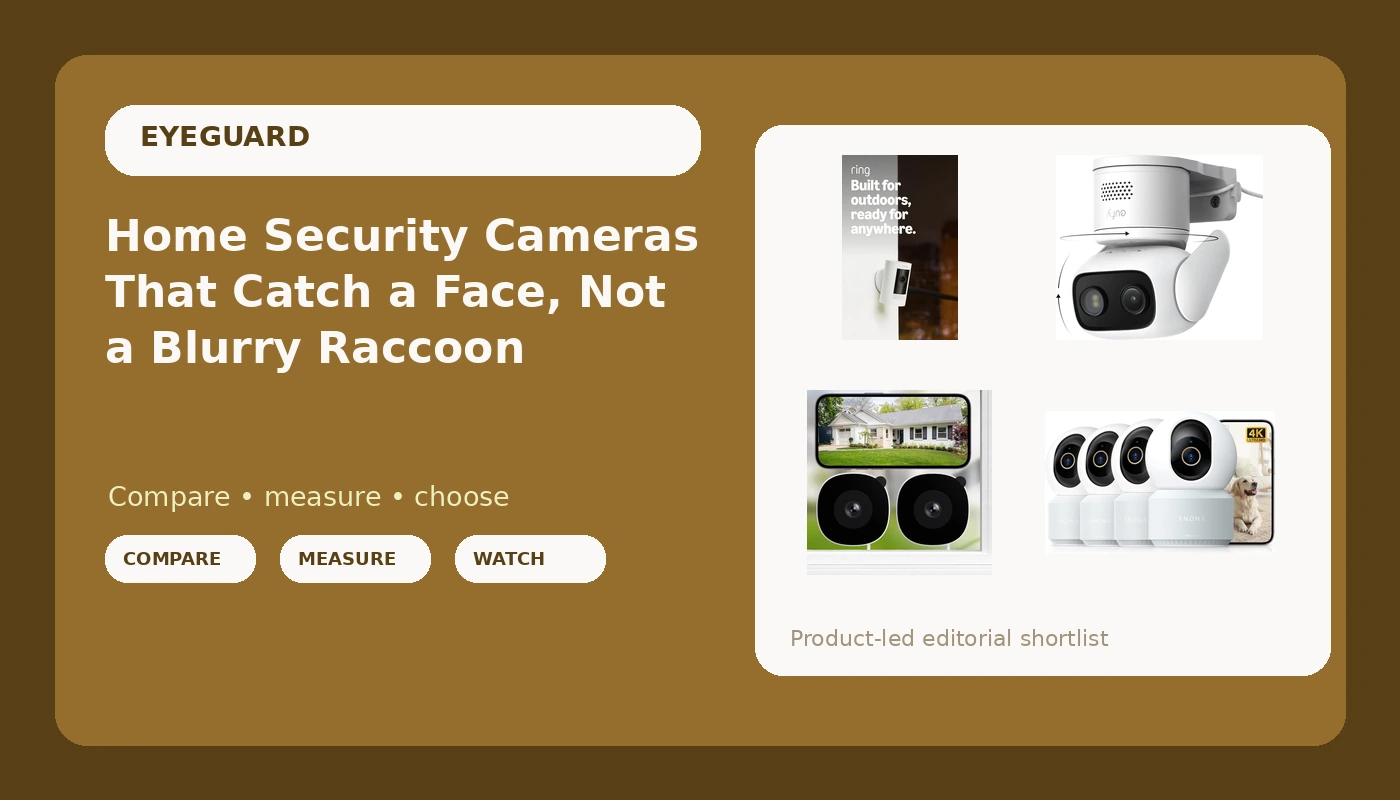
The four models below differ less in image quality than in where they can physically go and what they cost you after purchase. The Ring Outdoor Cam is the weather-rated exterior option built around live view, color night vision, and alerts. The eufy C31 adds motorized 360 degree pan and tilt with AI auto-tracking for indoor or sheltered outdoor use. The INFIYA window camera mounts with no drilling and looks out through glass, which matters if you rent. The Anona kit is an indoor four-pack aimed at covering several rooms at once. Choose your mounting constraint first, then compare night performance and where the footage lives.
Four useful options
| Model | Best fit | What stands out |
|---|---|---|
| Ring Outdoor Cam (Stick Up Cam) | Weather-exposed exterior walls and eaves | Weather-resistant housing, live view, color night vision, two-way talk, motion alerts, works with Alexa |
| eufy Security Indoor/Outdoor Camera C31 | Rooms or sheltered outdoor spots that need wide coverage | Indoor and outdoor use, 360 degree pan and tilt, AI auto-tracking |
| INFIYA 2K No Drill Window Camera, 2 Pack | Renters and any view that has to shoot through glass | 2K resolution, no-drill window mounting, indoor and outdoor monitoring, two cameras included |
| Anona 4K UHD Indoor Camera, 4 Pack | Covering several indoor rooms in one purchase | 4K UHD, 360 degree pan-tilt, 2.4G and 5G dual-band Wi-Fi 6, auto-tracking, person, pet, and baby crying detection, privacy mode, two-way audio, four cameras |
Weather-rated exterior option: Ring Outdoor Cam (Stick Up Cam)
The appeal here is placement freedom. A weather-resistant body means you are not limited to a porch ceiling or a window sill, so you can aim the camera down the actual approach path instead of at the door itself. Two things to weigh before you commit. First, Ring's stored video history runs through a Ring subscription plan, so the hardware is the down payment and the plan is the ongoing cost; read the current terms before you decide. Second, an exterior mount has to reach your Wi-Fi, so check signal strength at the spot you have in mind rather than at the spot you are standing in when you order.
Pan, tilt, and follow: eufy Security Indoor/Outdoor Camera C31
Pan and tilt is the feature people underestimate and then rely on. The trade-off is that a moving camera has a moving blind spot: while it is looking left, it is not looking right, and anything that crosses behind an obstruction can drop out of frame. Auto-tracking helps only as long as the subject stays visible. If your goal is a single camera covering a wide indoor space or a sheltered outdoor corner, this class of camera does more work per unit than a fixed lens. If your goal is a hard, reliable record of one doorway, a fixed camera pointed at that doorway is the safer design.
Through-glass mounting, no drilling: INFIYA 2K No Drill Window Camera, 2 Pack
This is the option I recommend to renters and to anyone whose landlord has opinions about masonry. It is also the option with the most specific failure mode. Shooting through glass adds a layer between the lens and the scene, and at night infrared illumination can bounce off the pane and wash out the image, the same effect that turns a close-up subject into a white blob on cheap cameras. Keep the room behind the camera dark, clean the glass on both sides, and angle the camera so it is not catching a streetlight or a reflection of a lamp. Done right, a window camera can watch a driveway or a sidewalk without a single hole in your house.
Four rooms, one purchase: Anona 4K UHD Indoor Camera, 4 Pack
Four cameras in one box changes the math. Instead of one camera trying to cover a hallway, a living room, and a back bedroom, you place a unit in each and stop moving the camera around. The detection types listed, person, pet, and baby crying, are the ones that actually reduce alert noise indoors, where a passing car is not the problem but a cat is. This is an indoor camera, so it does not replace a weather-rated exterior unit, and a four-pack means four power points and four Wi-Fi connections to plan for. Walk your rooms and count the outlets before you order.
Prices and availability may change. Product images, names, and retailer links must be matched by verified ASIN. Do not state a current price, rating, stock status, or measured result without current evidence.
Why night ID range matters more than resolution
Night ID range is the distance at which a camera captures a face or a plate you could actually hand to the police. Everything inside that range is evidence. Everything past it is decoration. This is why a 4K camera and a 2K camera can be equally useless on the same driveway: the bottleneck at night is usually illumination and exposure handling, not pixel count.
The classic failure is IR washout, where the infrared illuminator overexposes whatever is close to the lens while trying to reach something far away. The result is the footage I got: a bright, featureless blob in the foreground and darkness behind it. Resolution cannot fix that, because the detail was never captured.
The practical consequence is that you should stop comparing megapixels and start comparing behavior at distance. When you set up any of these cameras, put a person you can recognize at 10 feet, then 20, then 30, and look at the clip the next morning. If you cannot name the person at 20 feet, the camera will not help a detective either. This is also why the number and quality of alerts matter as much as the picture: a camera that fires on every passing car and every spider web gets muted, and a muted camera is not a security system.
The three-year cost question and where your footage lives
The subscription is the real price. The hardware is the down payment. A camera with a low sticker price and a mandatory monthly plan can cost more over three years than a more expensive camera that records to storage you already own, and that comparison almost never appears on a product page.
Before you buy, answer two questions. Where does the recording physically live: a memory card, a recorder in your house, or a vendor's cloud? And who else can see it, retain it, or be compelled to hand it over? Local storage means no subscription and no third party holding your clips, but it also means you are responsible for the card or the recorder and for backing it up. Cloud storage means convenience and off-site copies, and an ongoing bill plus terms that can change.
Do the arithmetic honestly. Take the hardware cost, add three years of any required plan, add a card or recorder if you want local copies, and compare that total rather than the number on the shelf.
- Measure the real distance from each entry point to the spot where a camera can actually be mounted, and write the number down.
- Decide the mounting type before the model: exterior wall, eave, window glass, or indoor shelf.
- Test night identification at 10, 20, and 30 feet with a person, not with a moving car or a pet.
- Total three years of hardware plus any subscription before comparing two cameras.
- Confirm where recordings are stored and who can access them.
Practical guidance for the install
- Aim the camera along the approach path, not at the door. Faces arrive before people reach the handle.
- Light the approach. A porch light gives any camera's color night mode something to work with.
- Set detection zones and sensitivity before you trust notifications. False alerts are the number one reason people mute their own cameras.
- Run a live night check at your real distances instead of trusting a spec sheet.
- Decide storage before purchase: card, in-house recorder, or subscription plan.
- Check power and Wi-Fi signal at the mounting spot before you drill or stick anything up.
Which option should you choose?
Choose the Ring Outdoor Cam (Stick Up Cam) when the camera has to live outdoors in weather and you want live view, two-way talk, and Alexa integration, and you are comfortable with a Ring plan for stored history. Choose the eufy Security Indoor/Outdoor Camera C31 when one camera needs to cover a wide indoor space or a sheltered outdoor corner and pan, tilt, and auto-tracking will do more for you than a fixed lens. Choose the INFIYA 2K No Drill Window Camera, 2 Pack when you rent, cannot drill, or need to watch a view through glass, and you are willing to manage reflections and interior light. Choose the Anona 4K UHD Indoor Camera, 4 Pack when you want several indoor rooms covered in one purchase and value person, pet, and baby crying detection over exterior durability.
One caveat applies to all four: mounting position and lighting will affect your results more than the model name on the box. None of these cameras can identify a face it never gets a clear look at, and no spec sheet can tell you how your specific driveway, hallway, or window will behave at 2 AM.
The bottom line
A security camera earns its place by capturing an identifiable face at the distance your entry points actually sit, at night, and by keeping that footage somewhere you control. Resolution is the easy number to market and the least useful one to compare. The Ring Outdoor Cam covers weather-exposed exteriors with color night vision and alerts. The eufy C31 covers more ground per unit with pan, tilt, and auto-tracking. The INFIYA two-pack solves the renter problem without drilling. The Anona four-pack covers several indoor rooms and filters alerts down to people, pets, and crying. Pick the one whose mounting constraints match your house, then test it at 10, 20, and 30 feet before you trust it with anything that matters.